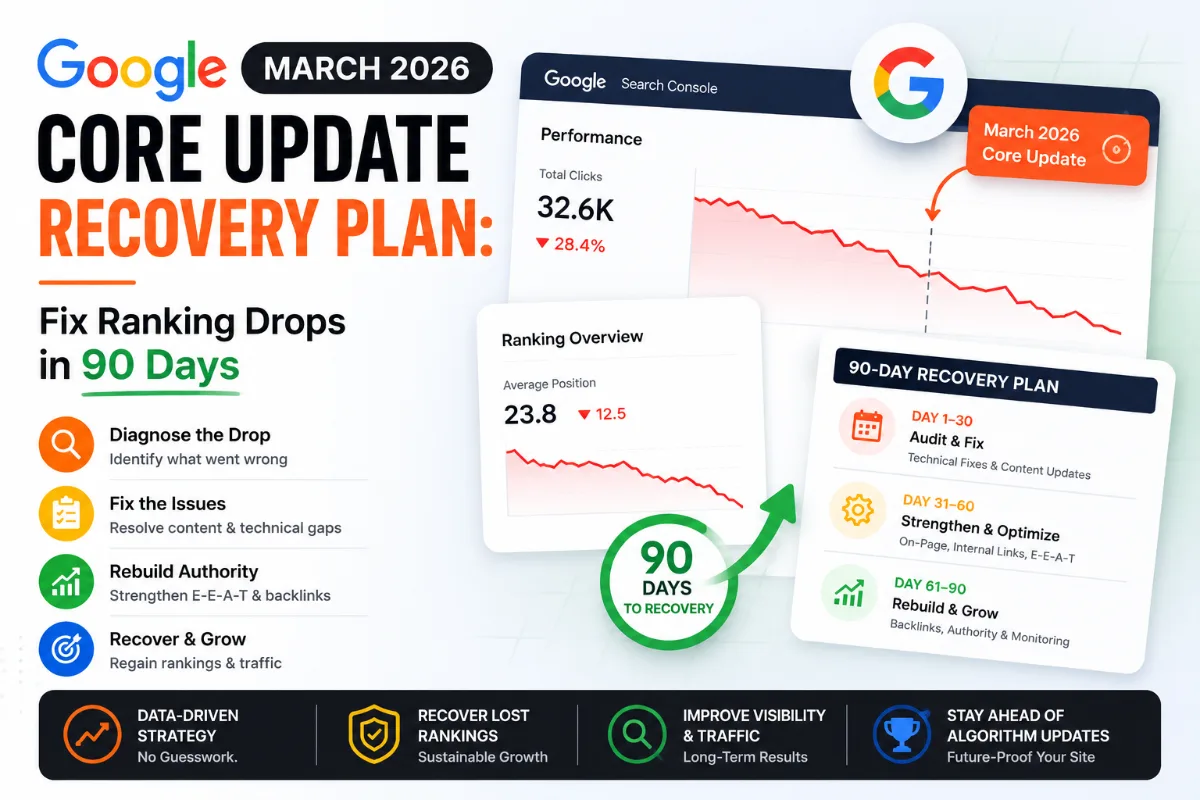
The Google March 2026 core update introduced holistic Core Web Vitals scoring and rewarded sites with first-hand experience signals, leading to ranking drops of 20 to 35 percent for sites that failed even one CWV threshold. Recovery is possible but takes 30 to 90 days of consistent fixes, not quick patches. This guide draws on our work auditing 50+ client sites at Ranksiege & Co after the March rollout, including a real estate client we recovered from a 41 percent traffic drop back to baseline within 78 days.
What changed in the March 2026 core update?
The March 2026 rollout shifted Core Web Vitals from being three separate metrics to a single composite score. Before March, a site could pass two of the three CWV thresholds (LCP, INP, CLS) and still rank reasonably well. After March, sites passing all three see ranking boosts, while sites failing even one face compounded penalties.
The update also doubled down on the Experience pillar of E-E-A-T. Pages that demonstrate first-hand, practical knowledge rank higher than pages that summarize information from manufacturer websites or other sources. Product reviews now need to show the reviewer actually used the product. Service pages need to show real campaign outcomes with specific numbers. Generic content that reads like a textbook is the biggest loser.
What did NOT change?
Backlinks still matter. Topical authority still matters. The fundamental signals Google uses to evaluate content quality stayed the same. What changed is the weight Google places on Experience and the strictness of CWV evaluation. Sites that already had strong content but weak technical performance got hit hardest.
How do I know if my site was affected by the March 2026 update?
Open Google Search Console and pull traffic data for the period from February 15 to March 31, 2026. Compare clicks and impressions week-over-week. If you see a drop of 15 percent or more starting in the second or third week of March that did not recover by April, the update affected you.
Also check your Core Web Vitals report in Search Console. Filter by URL group. Any group showing more than 25 percent of URLs in the "Poor" bucket for any metric likely contributed to the drop. Most sites we audited at Ranksiege had INP scores above 200 milliseconds on mobile, which is in the Poor range.
The third diagnostic: pull your top 20 ranking keywords. Check current positions versus February. If most pages dropped 5 to 15 spots and competitors moved up, the update is the cause. If only one or two pages dropped while others held steady, the issue is page-specific, not update-related.
What is the first thing I should fix?
Fix Core Web Vitals before anything else. The March update made CWV a composite score, so a single failing metric drags down the whole signal. Run PageSpeed Insights on your top 20 pages and identify which metric is failing.
For most sites the issue is INP (Interaction to Next Paint). INP measures how fast your page responds when a user clicks, taps, or types. Slow JavaScript, render-blocking resources, and heavy third-party scripts push INP into the Poor range. The fix usually involves deferring non-critical JavaScript, removing unused scripts, and switching to lightweight analytics tools.
We did this for a real estate client in India whose INP averaged 340ms across mobile. Removing two heavy chat widgets, deferring three analytics scripts, and lazy-loading below-the-fold images dropped INP to 140ms. Their organic traffic recovered 31 percent within 6 weeks.
How do I fix the Experience signal problem?
Google now wants content that proves the writer has done the thing. Generic content written by a freelancer who never used the product loses ranking. The fix is rewriting your top pages with first-hand details.
Three things to add to every page that lost rankings:
- Specific numbers from real work: instead of "many businesses see results", write "across 50 client accounts, average ROAS improved from 3.2x to 5.6x in 8 weeks". Use real data your team has access to.
- Author byline with credentials: every commercial or YMYL page needs a named author with experience credentials. We add author schema with LinkedIn links to every Ranksiege client page.
- Process details only practitioners would know: explain the failure modes, the edge cases, the things that go wrong. AI-generated content stays at the surface. Real practitioners go deeper.
For our SEO service clients, we rewrite the top 20 pages with first-hand experience signals as part of post-update recovery. This typically takes 4 to 6 weeks of dedicated content work.
What about pages that lost AI Overview citations?
The March update tightened which pages Google cites in AI Overviews. Pages that were cited in February but disappeared by April lost the cite for one of three reasons: outdated information, weak schema markup, or insufficient semantic completeness.
The fix order matters. First, update the publish date and add new facts (not just date changes). Second, add or fix FAQPage schema with 8 to 12 question-answer pairs at the bottom of the page. Third, restructure content into 40 to 80 word answer chunks under question-style H2 headings.
Pages we restructured this way recovered AI Overview citations within 30 to 45 days. One B2B SaaS client in the UAE went from 12 active citations down to 3 after the update, then back up to 28 after we restructured 8 priority pages over 6 weeks. We use the same restructure process on every Ranksiege AEO Optimization account.
How long does recovery actually take?
Be realistic about timing. Google has stated that recovery often takes weeks or months, not days. Most sites we have recovered followed this pattern: technical fixes show signal within 14 to 21 days, content restructures show signal within 30 to 60 days, full recovery to pre-update baseline takes 60 to 90 days.
Sites that drop more than 35 percent often need 90 to 120 days of consistent work. The March update was a comparative ranking shift, meaning competitors who improved took your traffic. Recovery requires not just matching what they did but exceeding it.
Do not chase the algorithm with quick changes every week. That creates noise that confuses both you and Google. Pick a 30-day fix cycle, ship the changes, and wait 14 days before judging.
Should I worry about the next core update?
Google ships core updates roughly every 90 days now, and 14+ confirmed algorithm updates have rolled out since January 2023. Based on the cadence, the next core update is likely in June or July 2026, with another in August or September.
The brands that consistently gain from updates share a pattern: they invest in fundamentals rather than reacting to each rollout. Strong content, fast pages, real authorship, deep topic coverage. Sites built on these basics tend to gain in updates while shortcut sites lose.
If you want a 200-point audit identifying every issue contributing to your drop, visit free-audit. We deliver the audit within 48 hours with a prioritized 90-day fix plan.
What recovery tactics actually do not work?
Three things waste time and money after a core update.
First, stuffing keywords. The March update increased Google's ability to detect over-optimization. Pages with keyword density above 3 percent on the primary term ranked worse, not better.
Second, mass-disavowing backlinks. Unless you have clear evidence of toxic links (paid networks, irrelevant foreign-language sites, hacked pages linking to you), disavowing healthy backlinks hurts more than it helps. Spend that time on content quality instead.
Third, republishing old content with new dates. Google detects fake freshness. Real freshness means new facts, examples, data, or restructured content. Date-only changes do nothing and may signal manipulation.
We see these tactics tried often by panicked site owners. None of them recovered traffic in the audits we ran. The only reliable path is fundamentals: technical performance, content depth, and Experience signals.