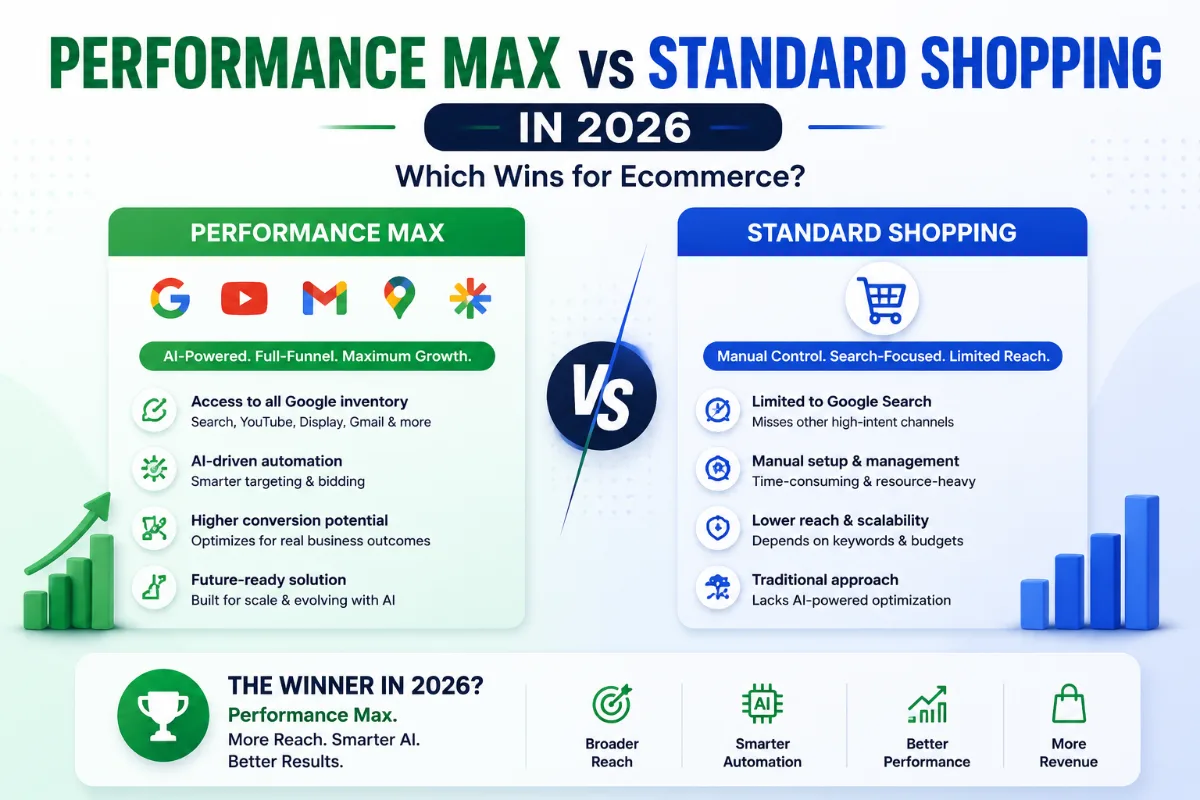
Performance Max delivers broader reach across YouTube, Gmail, Discover, Display, and Maps with average ROAS of 2.57 to 1, while Standard Shopping focuses on bottom-funnel buyers and averages 5.17 to 1 ROAS, according to Triple Whale's 2026 benchmark across 18,000 ecommerce brands. Picking the wrong one for your product mix can quietly burn 30 to 40 percent of your monthly ad budget. This guide draws on our work managing $50 million in ad spend at Ranksiege & Co to break down when each campaign type wins, where they overlap, and how to combine them for a 5.6x average ROAS like our ecommerce clients hit.
What is Performance Max and how does it differ from Standard Shopping?
Performance Max is Google's automated campaign type that runs ads across all Google surfaces (Search, Shopping, YouTube, Display, Discover, Gmail, and Maps) from a single setup. You provide assets and conversion goals, and Google's AI handles bidding, audience targeting, placement selection, and creative combinations.
Standard Shopping is the older campaign type, focused exclusively on Google Shopping placements. You upload a product feed, set bids, and your products appear in Shopping results when shoppers search for relevant queries. You have direct control over which products bid on which queries and can use negative keywords to exclude irrelevant traffic.
The key difference is control versus reach. Standard Shopping gives you tight bid control and clean attribution. Performance Max trades that control for broader reach and AI-driven optimization. Neither is universally better. Both have a place in mature ecommerce accounts.
What kind of advertiser does each suit?
Standard Shopping suits accounts that want predictable ROAS on proven SKUs. If your product margins are tight, your inventory is stable, and you have a clear list of bestsellers, Standard Shopping protects efficiency. Performance Max suits accounts that need to scale beyond Search, find new customers, and have at least 50 monthly conversions feeding the AI enough data to optimize.
Why does Performance Max have lower ROAS than Standard Shopping?
The ROAS gap between Standard Shopping (5.17x average) and Performance Max (2.57x average) is real but misleading. PMax is doing a different job. It captures upper-funnel inventory like Display and YouTube where users have not decided to buy. Standard Shopping captures bottom-funnel buyers who already typed in a product query.
The right comparison is not ROAS in isolation. It is incremental revenue. PMax brings in new customers Standard Shopping would never reach. We tested this on a D2C skincare client in the USA. Standard Shopping ran at 4.8x ROAS on bestsellers. Adding PMax dropped blended ROAS to 3.9x but increased total revenue by 87 percent. The lower ROAS came with much larger absolute profit. The client closed 90 days at $1.2 million in revenue.
When should I use Standard Shopping?
Standard Shopping is the right choice in five scenarios:
- Accounts with under 50 monthly conversions: PMax needs data to learn. Without enough conversions, it stays in exploration mode and burns budget.
- Tight-margin products: if your margin is under 20 percent, you cannot afford the broader matching of PMax. Standard Shopping lets you protect efficiency.
- Bestseller protection: for your top SKUs that already convert well, Standard Shopping holds tighter control over which queries they appear on.
- Brand defense: if competitors bid on your branded queries, Standard Shopping with brand-specific campaigns controls the auction more reliably than PMax.
- Newer accounts: accounts under 6 months old without conversion history should run Standard Shopping first to build data before testing PMax.
For our ecommerce clients on flat $199/mo Google Ads management, we usually start new accounts on Standard Shopping for the first 60 days, then layer in Performance Max once we have 50+ conversions per month.
When should Performance Max take over?
Performance Max wins in four situations:
- Scaling beyond Search: when you have maxed out Standard Shopping and Search and need to find new audiences on YouTube, Display, and Discover.
- Seasonal launches and new products: PMax ramps up faster on new SKUs because it pulls from broader signal pools than Standard Shopping.
- Mature accounts with 100+ monthly conversions: at this volume, the AI has enough data to optimize quickly. PMax often outperforms Search at the upper funnel.
- Multi-channel attribution clients: if you measure cross-channel impact rather than last-click ROAS, PMax's broader reach shows up in branded search lift and direct traffic increases.
We saw this pattern with a fintech client in the USA. Their Standard Shopping ROAS was 5.4x but capped at $40,000 monthly spend before efficiency dropped. Adding Performance Max scaled spend to $90,000 monthly at a blended 4.1x ROAS. Total profit doubled.
How do I split budget between Performance Max and Standard Shopping?
The split depends on account maturity. For accounts under 6 months old, run 100 percent Standard Shopping. For accounts with 50 to 100 monthly conversions, run 70 percent Standard Shopping and 30 percent Performance Max. For mature accounts with 100+ conversions, run 40 to 50 percent PMax and 50 to 60 percent Standard Shopping plus Search.
A practical rule we use at Ranksiege: keep your Superstar SKUs (top 20 percent of revenue) and Workhorse SKUs (next 40 percent) in Standard Shopping for ROAS control. Run PMax on Scout SKUs (newer or untested products) where broader exposure is more valuable than tight efficiency. This is the foundation of our ecommerce playbook for clients on our eCommerce SEO service and Google Ads combined.
What about the new Performance Max experiments and AI Brief tools?
Google rolled out three useful PMax updates in 2026. First, asset experiments came to Performance Max in April 2026, letting you test creative variants at the asset group level. Second, the AI Brief tool now lets you provide written guidance on messaging and audience targeting without rewriting every asset. Third, Performance Max experiments include three types: testing PMax against another campaign type, testing final URL expansion impact, and testing the uplift of adding PMax to existing campaigns.
The third experiment type is the most useful for the Performance Max versus Standard Shopping question. Run an Uplift experiment with Standard Shopping as the control and Standard Shopping plus PMax as the treatment. Each gets 50 percent of traffic for 30 days. The result tells you the incremental revenue PMax brought in.
How does Performance Max handle the Power Pack alongside AI Max?
Google's Power Pack pairs three campaign types: Demand Gen for awareness, AI Max for Search intent capture, and Performance Max for full-funnel orchestration. Each plays a distinct role in the customer journey.
In practice, the jury is still out on whether the full Power Pack outperforms a more focused approach. We have tested it on three client accounts. Two saw improved blended ROAS with the full stack. One saw no meaningful change. The pattern suggests Power Pack works best for brands above $30,000 monthly spend and 200+ monthly conversions. Below those thresholds, simpler is better.
For our typical ecommerce client at $5,000 to $15,000 monthly spend, we run Standard Shopping plus Performance Max plus a separate Brand Search campaign. That three-campaign structure consistently delivers our 5.6x average ROAS.
Should I run Brand Search separately from Performance Max?
Yes. Always. Brand Search runs at 6x to 12x ROAS because these are customers already familiar with your brand. They are the cheapest conversions in any account. If you let Performance Max absorb branded traffic, two things happen: PMax inflates its reported ROAS by claiming credit for cheap branded conversions, and you lose visibility into how much of PMax's performance comes from new customer acquisition.
Always run a dedicated Brand Search campaign with brand keywords, brand exclusions on every PMax campaign, and conversion goal segmentation. We do this on every Ranksiege ecommerce client account.
What is the realistic ROAS expectation for each?
Across the 18,000 ecommerce brands Triple Whale tracks in 2026, average industry ROAS sits at 3.68x. Standard Shopping averages 5.17x. Performance Max averages 2.57x.
Our Ranksiege ecommerce clients average 5.6x ROAS on Google Ads management. We hit this by running the three-campaign structure described above and refusing to set unrealistic ROAS targets that strangle scale. A 3x ROAS on a 70 percent margin product is highly profitable. A 5x ROAS on a 25 percent margin product might not break even after returns. Set ROAS targets based on break-even economics, not industry averages.
If you want a free 200-point audit of your current setup, visit free-audit. We deliver within 48 hours with a clear action plan.