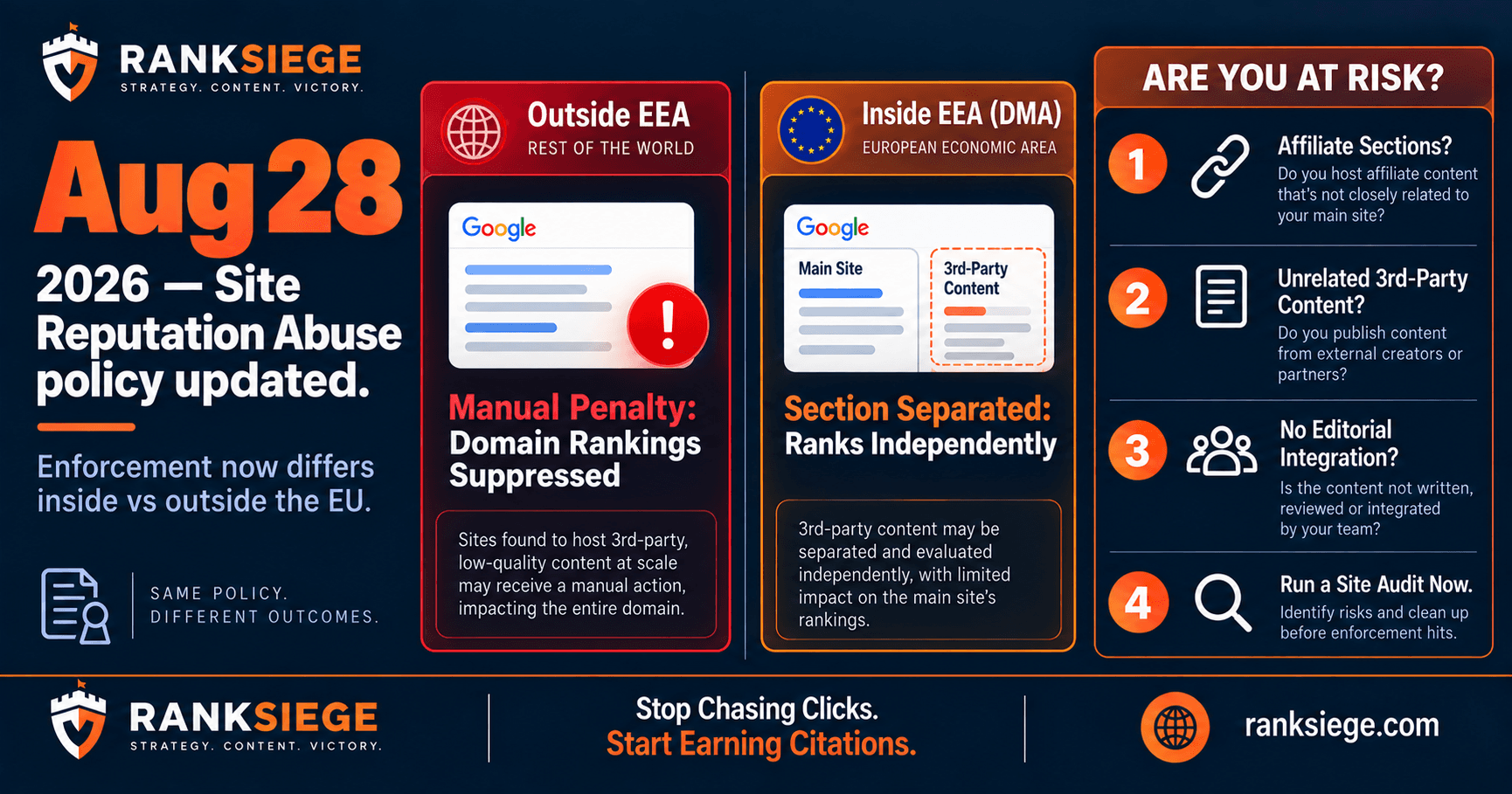
Google updated its Site Reputation Abuse policy on August 28, 2026, and the enforcement method changed in a way that affects how penalties work differently inside and outside the EU. If your site hosts third-party content like sponsored articles, white-label tools, affiliate sections, or independent microsites under your domain, this policy may affect you. This article explains what Site Reputation Abuse is, what changed in August 2026, and what you should do if your site carries third-party content.
What is the Google Site Reputation Abuse policy?
Site Reputation Abuse is Google's term for when a high-authority domain hosts third-party content that it would not normally publish, specifically to borrow that domain's ranking power for content the domain has no genuine relationship to. Google's classic example is a news site with a high domain authority hosting a payday loan comparison section written by an affiliate partner. The affiliate content ranks higher than it should because of the news site's authority, not because the affiliate section has earned its own ranking on merit.
Google first introduced the Site Reputation Abuse policy in May 2024. It targeted sites that allowed third parties to publish content on their domains specifically to manipulate search rankings. The original enforcement was a manual action: human reviewers identified violating sites and issued penalties that suppressed their rankings.
What changed in the August 28, 2026 update?
The August 28, 2026 update split enforcement into two separate paths based on whether the site operates inside or outside the European Economic Area.
Outside the EEA: enforcement remains a manual action. If Google identifies Site Reputation Abuse on a site outside the EEA, it can issue a penalty that directly suppresses the site's overall rankings or the specific violating section.
Inside the EEA: enforcement changed to comply with the EU Digital Markets Act. Instead of a penalty that affects the host domain's overall rankings, Google separates the third-party section algorithmically. The section is treated as an independent ranking entity rather than part of the host domain. This means the third-party content loses the benefit of the host domain's authority and must rank (or fail to rank) on its own merits, without affecting the host domain's core ranking performance.
The practical difference is significant. A UK-based publisher with a hosted affiliate section under their domain faces the same binary penalty as before: the section gets manually suppressed and the domain's rankings may be affected. A German publisher in the same situation under the new EEA rules would see their affiliate section separated and forced to rank independently, but their editorial content retains its existing authority.
Why did Google make the EEA enforcement different?
The EU Digital Markets Act requires that platforms operating in the EEA cannot use enforcement mechanisms that create an unequal playing field between their own content and third-party content in ways that harm competition. Applying a domain-wide penalty that punishes both the legitimate publisher and the third-party content would create the kind of broad platform leverage the DMA restricts. Separating the section algorithmically allows Google to enforce content quality rules without affecting the host publisher's non-violating content.
Does this policy apply to your website?
The Site Reputation Abuse policy applies to any website that hosts content produced by or for a third party under the domain's umbrella, where the purpose of hosting that content is to benefit from the domain's existing authority rather than because the content genuinely belongs on the site.
This is broader than it sounds. It can include:
- Affiliate comparison sections (mortgage rates, insurance quotes, credit cards) hosted on a general interest site
- White-label review platforms embedded under a media brand's subdomain
- Sponsored content hubs labeled as "Brand Studio" or "Partner Content" that are actually SEO-optimized for keywords unrelated to the host site's core editorial focus
- Press release distribution sections that accumulate third-party links under a domain
- Coupon and voucher sections hosted on news sites or professional publications
It does not apply to clearly labeled native advertising that follows Google's ad policies, editorial content where the host site genuinely vetted and published the piece, guest posts where the host's editorial team reviewed and approved the content, or user-generated content platforms where the platform's core function is user content hosting.
How do you know if your site is at risk?
The pattern Google penalizes is one where the third-party content was placed on the domain primarily because of the domain's authority, with little or no editorial relationship between the host and the content. Three signals suggest your site may be at risk:
Topical disconnection: your third-party content covers topics your site has no editorial history in. A legal news site hosting a casino bonus comparison section has no topical connection between its editorial identity and the affiliate content.
No editorial integration: the third-party section has its own navigation, its own brand, and shows no integration with the host site's editorial voice or content structure. It is clearly a separate site living under a borrowed domain.
Sudden keyword rankings: sections of your site started ranking for keywords in categories you did not deliberately target, coinciding with third-party content being published there.
If any of these describe sections of your site, it is worth auditing whether Google has applied or is likely to apply Site Reputation Abuse enforcement.
What should you do if you host third-party content?
The options depend on the nature of the third-party content and its relationship to your core site.
Option 1: Move to a separate domain. If the third-party content serves a legitimate business purpose but is genuinely disconnected from your core site, move it to its own domain. It will need to earn its own authority, but it avoids the policy risk for your main domain.
Option 2: Apply editorial integration. If the third-party content is relevant to your audience, integrate it editorially. Add your own commentary, have your staff review and annotate it, link it to your editorial content where relevant. The distinguishing factor Google looks for is genuine editorial involvement from the host, not just a domain umbrella.
Option 3: Disclose and de-optimize. If you are running sponsored content, label it correctly. Remove it from your sitemap if you do not want it indexed. Apply canonical or noindex tags to sections that should not be competing in search. This stops the section from benefiting from your domain authority, which eliminates the policy trigger.
Option 4: Reconsider the partnership. If the third-party content provides no genuine editorial value to your audience and exists only for affiliate revenue or external SEO purposes, removing it is the cleanest resolution. The revenue loss from removing one section is unlikely to offset the ranking risk to your core domain.
We have walked several clients through Site Reputation Abuse reviews. The most common outcome when we audit a site that may be at risk is finding one or two sections that were added by a previous marketing manager or agency as a revenue experiment, with no editorial integration and no topical connection to the site's core content. Removing these sections cleanly, with proper redirects and search console reconsideration requests where applicable, has restored or maintained rankings for the core site in every case we have managed.
What does this mean for B2B sites and agency clients?
The Site Reputation Abuse policy is most relevant to media companies, news publishers, and high-authority content sites that attract third-party partnership requests. It is less likely to affect a standard B2B software company or local service business, unless that business has agreed to host content from partners outside their core category.
For clients on our SEO plan, we include a site reputation check in the quarterly audit. We flag any hosted third-party sections, assess whether they create a Site Reputation Abuse risk, and recommend the appropriate resolution. If you are outside the EEA and carry third-party content, this is a risk that could produce a manual action. If you are inside the EEA and carry third-party content, the risk is that your hosted sections lose their current ranking positions without affecting your main domain.
In either case, the cleanest path is editorial clarity: your domain should host content that genuinely reflects your editorial identity and audience. Content that does not belong on your site from an editorial perspective is a liability, not just under Site Reputation Abuse but under broader E-E-A-T principles. Start with a free 200-point audit to assess whether your site carries this risk.