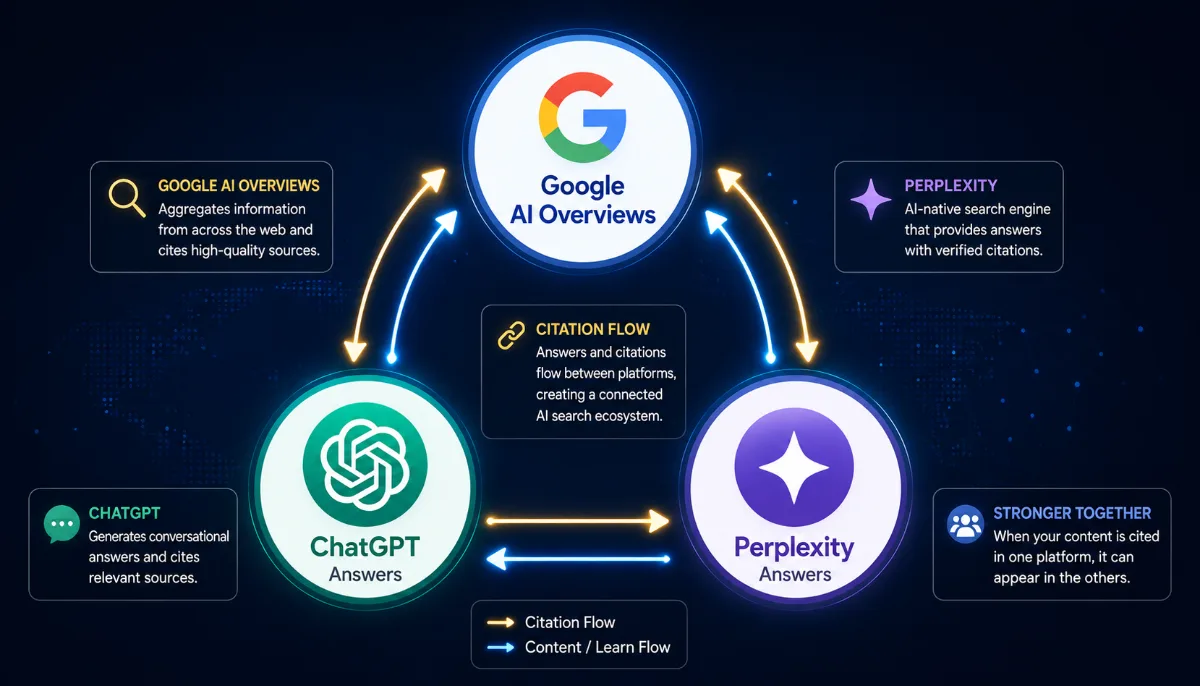
Getting cited by AI search engines requires a different playbook for each platform: Google AI Overviews favors brand-managed sources with strong topical authority, ChatGPT leans heavily on Wikipedia and Reddit, and Perplexity prioritizes community discussions. The same content can earn 615 times more citations on one platform than another, according to Superlines March 2026 data. This guide explains the platform-by-platform differences, what works on each, and the exact steps we use at Ranksiege & Co to land 40+ AI Overview citations per month for B2B SaaS clients.
Why are AI Overviews, ChatGPT, and Perplexity treated as separate channels?
Each platform pulls from different sources and rewards different content shapes. Citation overlap between Google AI Overviews and ChatGPT is only 12 percent. Content optimized for one is mostly invisible on the others. Treating AI search as one channel leaves 80 percent of citation opportunities on the table.
The volume gap is also large. AI Overviews now appears in 25 percent of Google searches according to Conductor's 2026 benchmarks, and 50 percent of all results by Google's own data. ChatGPT processes 2 billion queries daily with 883 million monthly users. Perplexity is smaller but growing fast, with peer discussions and lived-experience content driving 46.7 percent of its top citations. Each platform answers a different kind of question, so brands need a coordinated approach.
What does each platform optimize for?
ChatGPT favors encyclopedic content. Wikipedia accounts for 47.9 percent of its top 10 cited sources. Pages that read like a definitive reference, with clear definitions and supporting facts, win citations.
Google AI Overviews favors brand-managed pages and balanced source mixes. YouTube takes 23 percent of citations, Wikipedia 18 percent, Google.com 16 percent. Brand authority signals matter more here than on the other two.
Perplexity favors community signals. Reddit accounts for 46.7 percent of its top citations. Real conversations, lived experience, and peer reviews drive visibility.
How does Google AI Overviews pick sources?
Google's selection process is heavily tied to traditional search ranking, but not perfectly. About 76 percent of pages cited in AI Overviews also rank in Google's top 10. That means strong SEO foundations carry over, but a few additional signals matter on top.
The biggest is semantic completeness. Analysis of 15,847 AI Overview results showed content scoring 8.5 out of 10 or higher on semantic completeness was 4.2 times more likely to be cited. In plain terms: pages that answer the entire question, not just one slice, get picked more often.
Schema markup is the second factor. Pages with FAQPage schema and Author schema appear in AI answers up to 3 times more often than pages without. We add FAQPage and Article schema to every client blog post we publish, and citation rates have lifted by roughly 35 percent on the pages where we did this retrofit.
How important is freshness?
Pages updated within 60 days are 1.9 times more likely to appear in AI answers, according to BrightEdge data. Content updated within 30 days for ChatGPT specifically receives 3.2 times more citations than older content. Refreshing priority pages monthly is no longer optional. We do this for clients on our SEO service at $299/mo, refreshing the top 20 pages of any client site every 30 days as part of the retainer.
Why does ChatGPT cite Wikipedia and Reddit so heavily?
ChatGPT was trained on a snapshot of the web, and Wikipedia is an outsized share of that snapshot. When ChatGPT browses live during a query, it tends to anchor on sources its training data already trusts. Wikipedia and Reddit dominate that bias.
For brands, that has two implications. First, getting onto Wikipedia is hard but valuable when achievable. Second, contributing real, sourced answers on Reddit threads in your niche is one of the highest-impact activities for ChatGPT visibility. We have seen client brand mentions in ChatGPT answers grow 4 times after 90 days of consistent helpful Reddit participation, when matched with on-site content the Reddit answers point to.
Article length also matters on ChatGPT. SE Ranking analyzed 2.3 million pages and found articles over 2,900 words are 59 percent more likely to be cited than those under 800 words. Sections of 120 to 180 words between headings earn 70 percent more citations than pages with very short sections. The structure of the article you are reading right now follows those rules deliberately.
How do I get cited by Perplexity?
Perplexity rewards community signals more than the other engines. Reddit accounts for nearly half its top citations. The path to Perplexity visibility runs through forums, professional communities, and review sites where real users discuss your category.
Three things work. First, contribute substantive answers in subreddits relevant to your services. Generic promotional comments get downvoted and rarely cited. Detailed answers with personal experience and links to deeper resources do get cited. Second, build profiles on G2, Capterra, Trustpilot, or industry-specific review platforms. G2 is the most cited software review platform across all three engines. Third, encourage genuine customer reviews on Google Business Profile and your category's leading review sites.
Perplexity also values freshness. Citations rotate weekly in fast-moving categories. The brands that show up consistently are the ones updating content monthly and earning new community mentions every few weeks.
What is the single highest-impact thing I can do for AI search visibility?
Build semantic completeness on your top 20 pages. That is the unlock. Across ChatGPT, AI Overviews, and Perplexity, the trait shared by cited content is that it answers the question fully, in self-contained chunks, with clear structure and verifiable claims.
Concretely, this means each priority page should have:
- A direct one-sentence answer in the first 50 words
- 6 to 9 question-style H2 headings that match real searches
- 40 to 80 word answer chunks under each heading
- 10 FAQ items at the end with FAQPage schema
- 5 to 10 internal links to related cluster content
- An author byline with credentials
- A last-updated date within the past 90 days
We follow this exact pattern on every Ranksiege client page. One B2B SaaS client in the UAE went from zero AI Overview citations to 40+ per month inside 6 months using this structure. Their organic clicks rose 280 percent in the same window.
How do I track citations across all three platforms?
Manual checks work for small brands. Type your category's top 20 questions into ChatGPT, Perplexity, and Google with AI Overviews enabled, and note where you appear. This takes about an hour per round and we recommend doing it monthly.
For larger accounts, dedicated tracking tools like Topify, Profound, Rankscale, or SE Ranking's AI module track citation rates across multiple engines and store evidence trails. AI responses are non-deterministic, so the same query at 10am and 2pm can produce different answers. Time-stamped evidence is useful for stakeholders who want proof of citation share.
We track AI citations weekly for every Ranksiege client on AEO and GEO retainers. The reporting dashboard shows citation count, query coverage, and competitor share. If you want this set up for your account, our AEO service and GEO service start at $299/mo each.
What is the realistic timeline to start getting cited?
For Google AI Overviews, expect 60 to 90 days from publishing optimized content to first citations on your priority queries, assuming the page is internally linked and indexed quickly. Pages that already rank in the top 10 organically have a 33 percent chance of being cited in AI Overviews, so existing rankings matter.
For ChatGPT, the timeline is longer because ChatGPT's training cycles and live browsing biases favor older, more linked content. Expect 4 to 6 months for new content to enter ChatGPT's typical citation set, faster if the content gets backlinks from already-cited domains.
For Perplexity, the timeline can be shorter when community signals are strong. Brands actively contributing to relevant subreddits and earning legitimate reviews can see Perplexity citations within 30 to 60 days. Citation share is volatile though. ChatGPT's Reddit citation share fell from 60 percent to 10 percent in six weeks during late 2025. Plan for volatility.