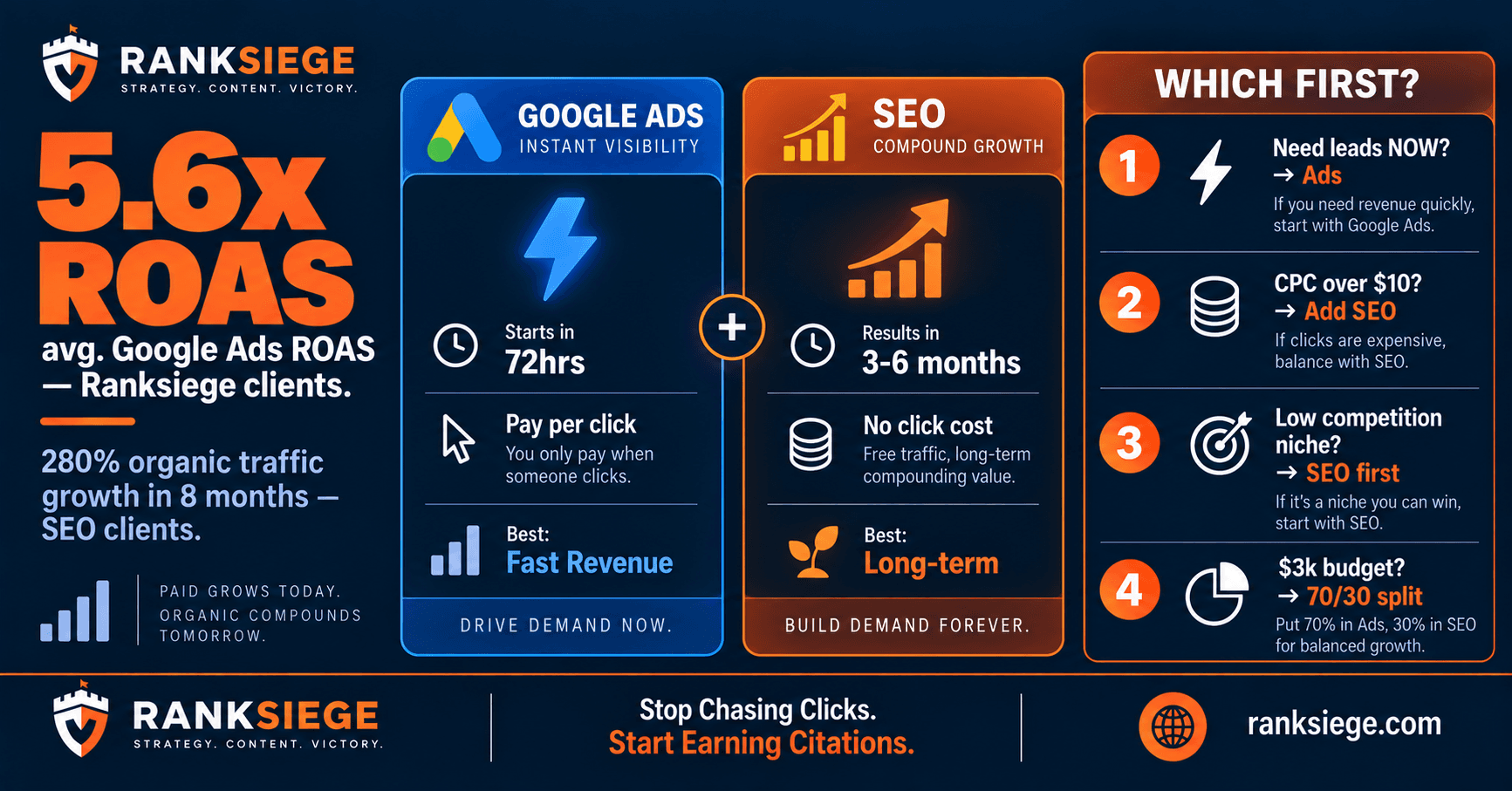
Google Ads and SEO are not competing strategies. They are different tools for different problems, and the right answer to "which one first" depends entirely on your business situation, not on which channel sounds more attractive. This article gives you a clear framework: what each channel does well, where each one fails, and how to decide which to start with given your budget, timeline, and growth stage.
What is the core difference between Google Ads and SEO?
Google Ads is paid traffic that starts the moment you fund the account. You pay for each click. When you stop paying, traffic stops. SEO is earned traffic: the work you do today compounds into organic rankings that send traffic without ongoing cost per click. But SEO takes 3 to 6 months to show meaningful results, and it requires consistent effort to maintain.
The decision is not about which channel is "better." It is about which one solves your current problem. A business that needs revenue this month cannot wait 6 months for SEO to compound. A business that cannot afford to pay $5 to $40 per click indefinitely needs an organic channel that works without an ongoing acquisition cost.
Both channels are more complicated in 2026 than they were in 2022. Google Ads now runs heavily through AI-automated campaigns (Performance Max, Demand Gen) that require specific setup discipline to avoid wasted spend. SEO now requires AEO structure for AI Overview visibility on top of traditional ranking requirements. The skill floor for both has risen.
When should you start with Google Ads?
Start with Google Ads if you need revenue in the next 60 days, if you have budget to sustain $1,500 to $3,000 per month in ad spend plus management, or if your category is highly seasonal and waiting 6 months for SEO to compound would mean missing your peak window.
Google Ads is also the right first channel if you do not yet know which keywords convert for your business. Running Google Search ads for 60 to 90 days gives you conversion data by keyword that is worth more than any keyword research tool. You learn which queries drive actual customers, not just visitors. That conversion data then informs which SEO keywords to prioritize, turning the ad spend into research investment.
The failure mode with Google Ads is funding it without the right structure. Across our Google Ads clients, the accounts that waste the most money share two patterns: they are running Smart campaigns with minimal control, or they are running broad match keywords without negative lists. One ecommerce client came to us spending $14,000 per month on Google Ads with a 0.9x ROAS. Within 30 days of restructuring into proper ad groups, adding over 200 negative keywords, and switching from Smart to manual CPC with a tROAS bid strategy, ROAS reached 4.8x. The problem was not the channel. It was the setup.
When should you start with SEO?
Start with SEO if you have a 6-to-12 month timeline before you need the investment to produce revenue, if your category has high search volume at keywords where the cost-per-click in Google Ads would be unsustainable (legal, financial, medical keywords often run $15 to $80 per click), or if your business model depends on recurring organic traffic rather than one-off paid acquisition.
SEO is also the right first channel if your competitors are not investing in it. In many B2B verticals and local service categories, SEO competition is surprisingly low. A plumbing company in a mid-size UK city can often reach page one for "plumber [city]" within 90 days with basic technical SEO and a few well-structured location pages, because competitors have not invested beyond a basic Google Business Profile. This kind of gap is not available in competitive niches, but it exists in many local markets.
The failure mode with SEO is expecting it to produce leads while ignoring conversion rate. We have taken clients from zero organic traffic to 280% growth in 8 months, only to find that their contact form was broken or their pricing page had no clear next step. Organic traffic without conversion infrastructure is a wasted investment. Fix the conversion path before you invest seriously in SEO.
What does $299 per month SEO actually get you?
At Ranksiege, $299 per month covers technical SEO, content creation following our AEO + GEO + E-E-A-T framework, schema implementation, internal link structure, and monthly Search Console reporting. It does not cover paid link acquisition (we do not do that) or content production at a frequency higher than two articles per month. For businesses in highly competitive national markets, $299 per month is a strong foundation but takes 9 to 12 months to compound to competitive traffic levels. For local businesses and mid-competition B2B categories, it is typically sufficient within 4 to 6 months.
Can you run Google Ads and SEO at the same time?
Yes, and in many cases this is the optimal approach. The channels complement each other in specific ways.
Google Ads keyword and conversion data improves SEO prioritization. You learn which keywords drive customers, not just visitors, before you invest 6 months of SEO work in a keyword that turns out to convert poorly.
SEO landing pages reduce Google Ads costs. When you are paying for ad clicks, the quality of the landing page affects your Quality Score, which affects your cost per click. A well-optimized landing page with proper E-E-A-T signals, fast load times, and clear conversion paths earns a higher Quality Score than a thin page. We have reduced client CPCs by 20 to 35% purely through landing page optimization without changing the ads themselves.
The combination also reduces risk. If your Google Ads account gets suspended (this happens, often without warning), organic traffic keeps your business visible. If your site loses organic rankings in a core update, paid ads can cover the gap while you recover.
What should a $3,000 per month marketing budget look like?
The right split depends on your stage. A business with no existing organic rankings and no customer revenue data should put 70% into Google Ads ($2,100 ad spend and management) and 30% into SEO ($299 per month SEO plus $600 for content) for the first six months. Use the Google Ads data to find converting keywords, then shift SEO work to target those keywords aggressively in month seven.
A business with existing organic rankings and proven converting keywords should reverse the ratio: 30% into paid ($900/mo to protect branded terms and capture high-intent competitors' keywords) and 70% into SEO content and link building to compound the organic advantage.
A business generating more than $50,000 per month in revenue from either channel should be running both at full scale, not trading off between them.
What is the minimum viable budget for Google Ads to work?
We do not take Google Ads clients below $1,500 per month in ad spend. Below that level, a Google Ads campaign does not generate enough click data in a month to make reliable optimization decisions. Campaigns in the learning phase burn budget on poor placements and need data to exit correctly. At $500 per month in ad spend, you will get roughly 50 to 100 clicks depending on your niche, which is not enough data to optimize a campaign meaningfully in 30 days.
The alternative to a minimum viable ad budget is choosing keywords strategically. A $500/mo budget works if you target only 3 to 5 very specific, low-competition long-tail keywords where the CPC is under $3. This limits reach but produces enough click data to learn. We can design this kind of focused campaign for clients who are testing the channel before scaling.
What about Meta Ads as an alternative to Google Ads?
Meta Ads (Facebook and Instagram) differ from Google Ads in a fundamental way: Google Ads captures demand that already exists, while Meta Ads creates demand in users who were not searching for your offer.
For businesses with products or services that are discoverable only when someone needs them (emergency plumbing, tax filing, dentists), Google captures the moment of need directly. Meta would require convincing the user they have a problem before showing them the solution. For businesses with products people discover visually or aspirationally (fashion, fitness, travel, home decor), Meta often outperforms Google because the discovery mechanism matches the product.
In our work across $50M+ in managed ad spend, the ROAS difference between Google and Meta depends entirely on category. A D2C skincare brand generated $1.2M in revenue in 90 days on Meta Ads for a client in the USA. A B2B SaaS company in the UAE saw 70% lower CPA on Google Search than on Meta because their buyers were actively searching for the solution, not waiting to be convinced.
Which channel is right for your business?
Run this four-question test:
1. Do you need revenue in the next 60 days? → Google Ads first.
2. Is your cost per click in Google Ads above $10 for your core keywords? → Build SEO alongside Ads, not instead of it.
3. Are you in a category where competitors have weak organic presence? → SEO first, significant opportunity.
4. Do you sell something people discover rather than search for? → Meta Ads deserves consideration before Google.
If your answers point in two directions, start with Google Ads to generate cash flow and conversion data, then layer SEO in month three. By month nine, you will have a compounding organic channel funded by the revenue the Ads produced in months one through six.
Our $199/mo Google Ads management and $299/mo SEO plans are designed to work together. Both run without contracts. If you want to know which channel will produce the fastest return for your specific business, start with a free 200-point audit. We assess your category competition, your existing online presence, and your budget to give you a direct recommendation, not a generic one.