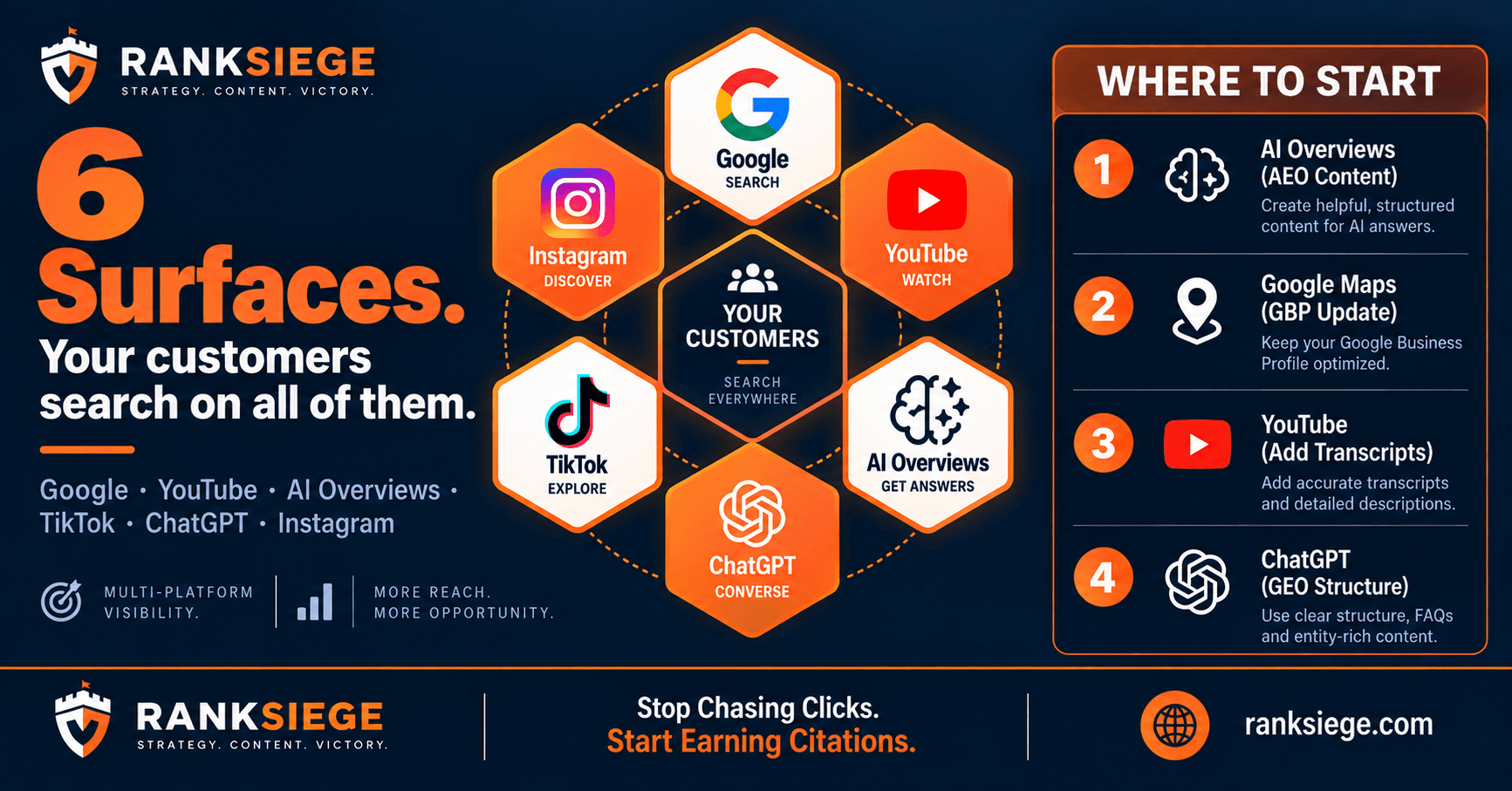
Ranking on Google is still valuable, but it is no longer the complete answer to online visibility in 2026. Customers find businesses through Google Search, Google Maps, AI Overviews, YouTube, Instagram, TikTok, ChatGPT, Perplexity, and increasingly through AI agents monitoring the web on their behalf. A brand that dominates page one of Google but has no presence in these other surfaces is invisible to a growing share of its target audience. This article covers what multi-surface visibility means, where it actually matters, and how to build it systematically.
What is multi-surface visibility and why does it matter now?
Multi-surface visibility means your brand appears consistently across every surface where your customers search or discover information. In 2023, "visibility" meant your position on Google Search. In 2026, it means your presence across Google Search, Google Maps, Google Discover, YouTube Search, TikTok Search, AI Overviews, AI Mode, ChatGPT web search, Perplexity, Microsoft Copilot, and Google's Platform Properties reporting in Search Console.
This is not a trend to consider later. Google itself confirmed the shift on July 29, 2026, when it made Platform Properties globally available in Search Console. You can now track your content's performance on Instagram, TikTok, YouTube, and X directly inside Google Search Console, alongside traditional Search and Discover data. Google is telling its users: these surfaces are all part of search now.
The customer journey rarely stays on one platform. Someone might first discover a B2B software company through a TikTok video. They research it further through ChatGPT. They confirm it by checking Google reviews. They click an organic result on Google Search to view pricing. A brand with only Google Search coverage loses the customer at the first three touchpoints of that journey.
Which surfaces matter most for business visibility in 2026?
Not every surface matters equally for every business. The relevant surfaces depend on what you sell and who you sell to.
Google AI Overviews now appear on a majority of informational and commercial research queries. If you are in a B2B or high-consideration service category, your target buyer is reading AI Overviews before they ever visit your site. Being cited in AI Overviews requires AEO-structured content with proper schema, named authorship, and factual specificity.
YouTube matters for any product that benefits from demonstration: software, physical tools, coaching, food and beverage, fitness. YouTube is the second largest search engine. For many queries, a YouTube result appears in Google Search above organic web results. If your competitor has a product demo video and you do not, they have visibility you do not.
Google Maps and Local Pack matter for every service-area business. A plumber, a dentist, a roofing contractor, an accountant: their first discovery touchpoint is often a map result, not a webpage result. Google Business Profile is required, but so is local SEO that builds entity signals consistent with your map listing.
ChatGPT and Perplexity matter for B2B and research-heavy categories. Business buyers who used to start their research on Google are increasingly starting with AI chat. These systems pull from the web, which means your website's authority and structure directly affect whether you are cited when a user asks an AI "what are the best options for [category] software?"
TikTok Search matters for D2C brands targeting under-35 consumers. TikTok's search index is growing, and for consumer categories (beauty, food, fashion, fitness, gaming), TikTok is now a primary discovery platform.
What about Instagram and X?
Google's Platform Properties integration in Search Console now tracks Instagram and X performance alongside other platforms. Instagram matters for visual-discovery categories: food, travel, interior design, fashion, real estate. X (formerly Twitter) has reduced visibility for most brand categories since it was excluded from many Google crawl agreements, but Google still indexes some X content. The Platform Properties data in Search Console will show you whether your Instagram content is surfacing in Google Discover or Google Search, which is a signal worth monitoring.
How does multi-surface visibility affect your SEO strategy?
Traditional SEO was focused on optimizing one asset: the webpage. Multi-surface SEO requires optimizing multiple asset types simultaneously: blog articles, video scripts, Google Business Profile posts, short-form social content, and schema-structured pages.
The good news is that the foundational work overlaps. Content that performs well in AI Overviews (factual, specifically attributed, structured with schema) also performs well when cited by ChatGPT and Perplexity. Content that demonstrates E-E-A-T for Google Search also signals credibility to YouTube's algorithm and to AI systems sourcing citations.
The additional work is format diversification. A blog article covers Google Search and AI Overview surfaces. The same information turned into a YouTube explainer video covers YouTube Search. A 60-second summary posted to Instagram Reels covers Discover and Instagram Search. The same FAQ section, with a few adjustments, works as a TikTok script. You produce the research and expertise once. You distribute it across surfaces.
What does GEO mean and how does it fit into multi-surface visibility?
GEO (Generative Engine Optimization) is the practice of optimizing content to be cited by AI systems like ChatGPT, Perplexity, Gemini, and Claude. Where SEO aims for search engine ranking positions, GEO aims for AI citation. Both matter because different parts of your customer base use different discovery systems.
GEO requires content that is factually precise, clearly attributed to a named source, structured with schema, and written in formats that AI systems can extract without surrounding context. The AEO Answer Block (a standalone 60-90 word paragraph after the H1 that answers the question completely) is the primary format for GEO citation. AI systems cite this block directly.
We have integrated GEO into our SEO service for all clients since late 2025. The principle is simple: write content so that every important claim stands alone as a citable statement. "Ranksiege clients achieved 280% average organic traffic growth in 8 months" is a citable statement. "Our clients see great results" is not. AI systems cite the former, ignore the latter.
How do you measure multi-surface visibility?
Measuring multi-surface visibility requires combining data from several reporting systems. No single dashboard tracks all surfaces in 2026, but the key data sources are:
Google Search Console now covers Google Search, Discover, News, Maps, YouTube, Instagram, TikTok, and X through the Platform Properties feature. This is the most comprehensive single tool available and should be checked weekly.
YouTube Studio shows your video search rankings and impressions on YouTube, which you correlate with Search Console to see how YouTube content drives Google-visible performance.
ChatGPT and Perplexity: these do not currently offer brand mention reporting. The proxy measure is monitoring branded search volume in Search Console for correlations with periods when you produce citation-optimized content.
Google Business Profile Insights covers local search and maps performance. Monthly check of calls, direction requests, and website clicks from the map listing tells you how your local surface is performing.
Is there a single tool that tracks all surfaces?
No single tool tracks all surfaces in 2026. The closest approximation is Google Search Console (now with Platform Properties) plus YouTube Studio plus a social listening tool like Mention or BrandWatch for AI citation monitoring. We are building custom Looker Studio dashboards for our clients that combine Search Console (all surfaces) with YouTube Studio data and branded search volume trends as a GEO proxy metric.
What should you do this month to start building multi-surface visibility?
Start with what you already have. If you have a blog, audit it for AEO structure so Google AI Overviews can cite it. If you have a Google Business Profile, update it with current photos, services, and a recent post. If you have a YouTube channel, add chapter markers and transcripts to your existing videos (these are indexed by Google Search).
The second step is checking your Platform Properties data in Search Console. If you have not connected Instagram, YouTube, or TikTok to your Search Console property, do that now. You may already have content performing on those platforms that you are not measuring. We have audited clients whose Instagram posts were appearing in Google Discover thousands of times per month with zero awareness on the client's end.
The third step is picking one new surface to develop. Do not try to build presence on all platforms simultaneously. Pick the one where your target audience already spends time and is not well served by your competitors. For most B2B service businesses, that is YouTube or AI Overview citations. For D2C brands, it is TikTok or Instagram.
For Ranksiege clients, multi-surface visibility is part of our SEO and GEO service from month one. We assess which surfaces matter for your category, connect all platform properties in Search Console, and build a content plan that covers at least two surfaces beyond traditional Google Search. Start with a free 200-point audit to see where your surface gaps are.