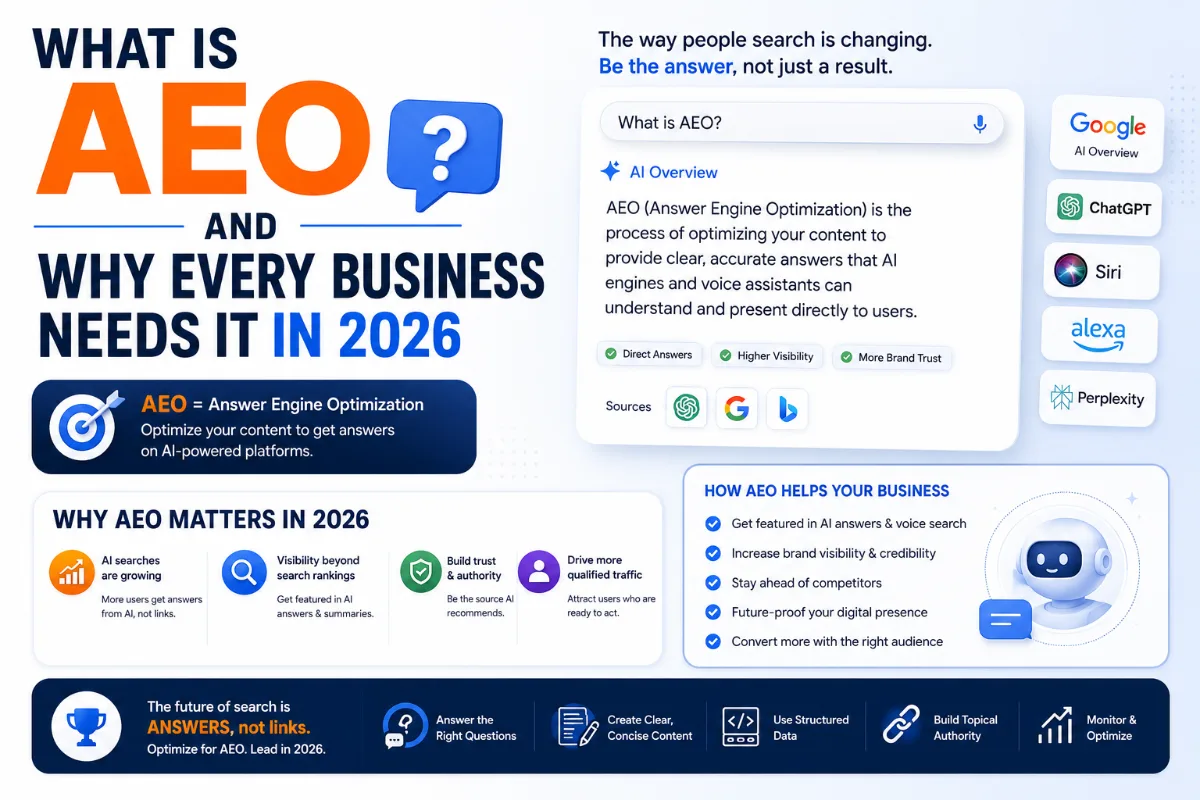
AEO (Answer Engine Optimization) is the practice of structuring content so it gets cited by AI-powered answer engines like Google AI Overviews, ChatGPT, Perplexity, and Gemini, where users now get answers without clicking through to websites. AI Overviews appear in 50 percent of Google searches in 2026, and organic CTR drops 61 percent on those queries unless your site is the cited source. This guide explains what AEO is, how it differs from SEO, and what businesses need to do to stay visible in this new search world. The lessons here come from our work helping clients earn 40+ AI Overview citations per month at Ranksiege & Co.
What does AEO actually mean?
AEO stands for Answer Engine Optimization. It is the process of formatting your content so AI systems can pull a clean, citable answer from your page. Instead of optimizing for click-throughs from a search results page, AEO optimizes for being the source that AI tools quote when they answer a user's question.
The shift matters because users behave differently now. Before 2024, a user typed a question, got 10 blue links, and clicked one. Now they type a question, read the AI Overview at the top, and often never click anything. Around 43 percent of AI Overview searches end without a click. In Google's AI Mode, the figure is 93 percent.
If your site is not the cited source, you are invisible. AEO exists because businesses need a strategy for that new reality.
How is AEO different from SEO?
SEO optimizes for ranking in the 10 blue links. AEO optimizes for being cited as a source inside the AI summary that sits above those links. Both still matter, because pages that rank in the top 10 are 33 percent more likely to be cited in AI Overviews. But ranking alone is no longer enough.
The skills overlap heavily. Both rely on quality content, schema markup, fast pages, and topical authority. The difference is structure. AEO requires direct one-sentence answers, question-based headings, 40 to 80 word answer chunks, and FAQ sections at the bottom of every priority page.
Why do businesses need AEO right now?
Three numbers explain the urgency. AI Overviews appear in 25 percent of Google searches as of early 2026, up from 13 percent a year earlier. ChatGPT processes 2 billion queries daily with over 880 million monthly users. AI search traffic converts at 14.2 percent compared to Google's 2.8 percent.
That last number is the kicker. AI search visitors are roughly 5 times more valuable per click than regular Google traffic. They have already done their research inside the AI tool. By the time they click through to your site, they are ready to act. Businesses cited in AI answers earn 35 percent more organic clicks and 91 percent more paid clicks than competitors not cited.
The brands that adopted AEO in 2024 and 2025 now dominate their categories in AI search. The brands that wait until 2027 will spend years catching up. The window to lead is open in 2026 and starting to close.
What kinds of content get cited by AI engines?
Three content patterns earn the most citations across Google AI Overviews, ChatGPT, and Perplexity.
First, in-depth guides. Articles over 2,900 words are 59 percent more likely to be cited on ChatGPT than shorter ones. Long-form guides that fully cover a topic get cited more than thin posts.
Second, structured comparisons. Comparison pages with 3 tables earn 25.7 percent more citations. Listicles with 8 list sections earn up to 26.9 percent more citations. The structure makes the content easy for AI to extract clean answers from.
Third, FAQ-rich pages. Pages with FAQPage schema and inline citations are weighted roughly 40 percent higher in AI Overview source selection. Adding a 10-question FAQ section at the bottom of every priority page is one of the highest-impact AEO tactics available.
What do I need to add to my website to start with AEO?
Six elements turn an existing page into an AEO-ready page. We add these to every client page at Ranksiege:
- Direct one-sentence answer in the first 50 words: state the answer to your headline question right at the top, before any context.
- Question-style H2 headings: phrase main sections as questions a real person would type. "How does X work" beats "X explained".
- 40 to 80 word answer chunks: under each H2, the first paragraph should give a complete, citable answer that stands alone.
- FAQPage schema with 8 to 12 Q&A pairs: at the bottom of each page, with proper schema markup for Google to recognize.
- Author byline with credentials: pages with author schema are 3 times more likely to appear in AI answers.
- Last-updated date within 60 days: pages updated within 60 days are 1.9 times more likely to be cited.
Doing these six things lifts AI citations across all major engines simultaneously. We see consistent results applying this pattern to client sites.
How long until AEO produces results?
For Google AI Overviews, expect 60 to 90 days from publishing optimized content to first citations on priority queries, assuming the page is internally linked and indexed quickly. Pages already ranking in the top 10 organically have a 33 percent chance of being cited.
For ChatGPT, the timeline is longer. Expect 4 to 6 months for new content to enter ChatGPT's typical citation set, faster if the content earns backlinks from already-cited domains.
One of our B2B SaaS clients in the UAE went from zero AI Overview citations to 40+ per month within 6 months by following this exact AEO process. Their organic traffic rose 280 percent in the same window.
Does AEO replace SEO?
No. AEO and SEO work together. SEO builds the foundation of rankings, backlinks, and authority that AEO needs to use. AEO adds the structural and formatting changes that turn ranking pages into AI-cited pages.
About 76 percent of pages cited in Google AI Overviews also rank in the top 10 organically. That overlap means strong SEO carries over to AEO directly. Sites that ignore SEO and try to do AEO alone struggle. Sites that do both win the new search world.
Our SEO service at $299/mo includes the SEO foundations. Our AEO service at $299/mo handles the AEO-specific structural work. Many clients run both together.
What about ChatGPT, Perplexity, and other AI tools?
AEO traditionally targets Google AI Overviews and featured snippets. The cousin discipline, GEO (Generative Engine Optimization), targets ChatGPT, Perplexity, Claude, and Gemini. The tactics overlap heavily, but each engine has its own preferences.
ChatGPT favors Wikipedia-style authoritative content. Perplexity favors community signals like Reddit. Google AI Overviews favors brand-managed sources with strong topical depth. Brands serious about AI search visibility eventually need both AEO and GEO running in parallel.
For most small and mid-sized businesses, starting with AEO and adding GEO once AEO is established works well. Our GEO service handles the broader AI search optimization for clients who want presence across all engines.
What does success in AEO look like?
Three metrics tell you AEO is working.
First, citation count. Track how many times your priority pages get cited per month in AI Overviews and AI engines. Use tools like Topify, Profound, or SE Ranking's AI module to track this automatically. Manual checks work for small budgets.
Second, branded search volume. AEO success creates word-of-mouth lift. Users who see your brand cited in AI answers often search for your brand name later. Watch branded search trends in Search Console.
Third, AI-referred traffic in GA4. AI engines now show up as referral sources in Google Analytics 4. ChatGPT, Perplexity, and Claude.ai all appear as distinct referrers when users click through. Track this segment separately. AI-referred traffic converts higher than regular organic, so it deserves its own attention.
For a free 200-point AEO audit of your site, visit free-audit. We deliver within 48 hours.