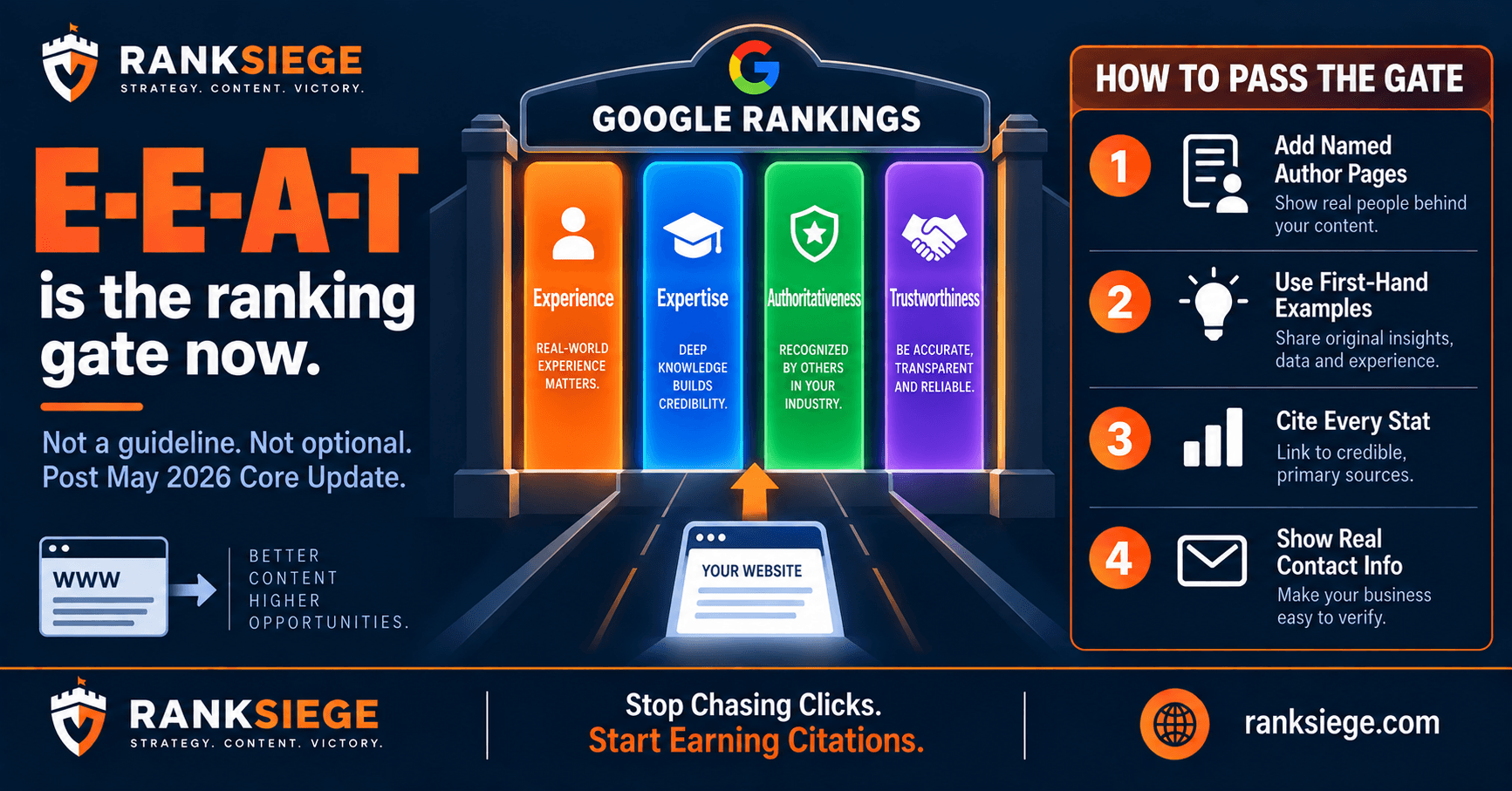
E-E-A-T is not a nice-to-have checklist anymore. After the May 2026 Core Update, sites with weak E-E-A-T signals lost rankings they had held for years. Sites with strong E-E-A-T signals held or gained. The evidence is now clear enough to say plainly: E-E-A-T is the gate. If your content does not pass it, ranking is harder regardless of how many words you publish or how many links you build. This article explains what E-E-A-T actually requires in 2026, how Google measures it, and what to do if your site has gaps.
What is E-E-A-T and how did it change in 2026?
E-E-A-T stands for Experience, Expertise, Authoritativeness, and Trustworthiness. Google's Quality Raters Guidelines define these four dimensions as the basis for evaluating whether a page's content serves the user well. The guidelines have existed since 2014, when they covered Expertise, Authoritativeness, and Trustworthiness (E-A-T). Google added the first E for Experience in December 2022.
The 2022 addition of Experience changed the framework significantly. Experience means the author has directly done the thing they are writing about, not just researched it. A review of a hotel written by someone who stayed there demonstrates Experience. The same review written by someone who read other reviews does not.
In 2026, Google's systems appear to detect Experience signals technically, not just through quality rater assessments. First-person language, specific dates and locations, photos with metadata, and named attributions all contribute to Experience signals that ranking algorithms now weight. The May 2026 Core Update reinforced this: content with no first-person experience signals, no named author, and no verifiable credentials lost rankings.
Why does Experience matter more now than it did in 2024?
The shift happened because AI-generated content exploded between 2023 and 2025. AI tools can produce content that covers a topic comprehensively and that reads like it was written by a knowledgeable human. But AI cannot have first-hand Experience. An AI cannot say "when I installed this software last March and it crashed on the third attempt, I found that the fix was..." because there was no installation. There was no March.
Google's response was to weight Experience signals more heavily as a differentiation factor between AI-generated content and human-produced content. Content with verifiable first-hand experience now has a ranking advantage that was not clearly measurable in 2024.
This does not mean AI-assisted content fails automatically. It means AI-assisted content that lacks first-person evidence, named authorship, and specific situational detail is at a disadvantage compared to content that has those signals. Adding real experience signals to an AI draft is the practical solution. Replacing AI content with entirely human-written content is not necessary, but the experience signals must be genuine, not fabricated.
What counts as an Experience signal?
Concrete Experience signals include:
- First-person account: "I tested this for three weeks with four different accounts"
- Specific outcomes: "We reduced our client's CPA from $68 to $22 in six weeks"
- Situational detail: "This approach works for ecommerce but fails for B2B SaaS because the sales cycle is too long for it to compound"
- Visual evidence: photos, screenshots, or videos with verifiable metadata showing the author did the thing
- Specific dates and contexts: "When we ran this during Black Friday 2025 for a D2C skincare brand in the USA..."
What does Expertise look like in 2026?
Expertise is knowledge depth. Not surface-level awareness of a topic, but a demonstrated command of the subject that produces information a reader cannot find by visiting the first five results on Google.
In 2026, Expertise is evaluated both through content signals and through author signals. Content signals for Expertise include: specific technical terms used correctly, original data or analysis, content that corrects or adds nuance to widely repeated claims, and specific tool names and methodologies named and applied correctly.
Author signals for Expertise include: a named author page with verifiable credentials, bylines that match an author profile with real professional history, schema with the author's name linked to an author URL that returns relevant information, and consistent bylines across multiple articles indicating a real ongoing contributor.
A recurring failure we see in site audits is that the site has genuine Expertise (the person who runs it knows the topic deeply) but the content does not demonstrate it. Articles are written at a general level to appeal to the broadest possible audience, with the specialist knowledge held back. This approach loses rankings to competitors who show their knowledge depth openly.
What is the difference between Authoritativeness and Expertise?
Expertise is what you know. Authoritativeness is what others recognize you for knowing.
Authoritativeness comes from off-page signals: links from recognized entities in your field, mentions in industry publications, citations in other expert content, a Google Knowledge Panel that associates your brand with specific topics, and consistent naming across professional profiles.
For a business, Authoritativeness is built through consistent publishing in one domain (so Google's entity graph associates the brand with the topic), through getting linked from credible sources in the industry, and through having real-world credentials that show up in search results when someone searches the author's name.
One practical way to strengthen Authoritativeness for business blogs: get your authors to publish expert commentary on other industry sites, not as a link-building tactic but as genuine contributor activity. When an author has published in Search Engine Journal, Ahrefs Blog, and their own site, their byline carries cross-entity authority. That cross-entity recognition signals Authoritativeness to Google's systems in a way that self-publishing alone cannot match.
Can a small business build Authoritativeness without a major publication?
Yes. Authoritativeness is relative to your topic and market, not absolute. A roofing company that consistently produces accurate, specific, first-hand roofing content builds Authoritativeness in the roofing topic cluster over time. A B2B SaaS company that contributes accurate, specific content to industry forums, is cited in podcast interviews, and has real client testimonials from named users builds Authoritativeness in its product category.
The mistake is pursuing broad Authoritativeness. You do not need to be cited in The New York Times. You need to be recognized by the entities Google's algorithm already associates with your topic.
What does Trustworthiness require in 2026?
Trustworthiness is the most basic and the most frequently missing dimension. It requires that your site is transparently honest about who you are, what you do, and what your content is based on.
Trustworthiness signals that consistently appear in high-E-E-A-T sites:
- A real About Us page with named individuals and their actual roles and backgrounds
- Contact information that works: a real address, a phone number that connects, an email that is monitored
- Author bios with verifiable credentials (not "a team of experts" as a byline)
- Clear disclosure of sponsored or affiliate content
- Accurate factual claims with sources cited
- Content that acknowledges limitations and uncertainty where they exist
Sites that obscure their ownership, use generic team bios, publish outdated statistics without disclosure, or make claims that cannot be verified fail the Trustworthiness dimension. These sites lost rankings in the May 2026 Core Update proportionally to the number of Trustworthiness signals they were missing.
We set the WhatsApp number, email address, and free audit link prominently in every article we produce for Ranksiege clients. This is not just a CTA strategy. It is a Trustworthiness signal. A contact method that works is evidence of accountability.
How do you audit your site for E-E-A-T gaps?
A practical E-E-A-T audit checks four areas:
Author transparency: every article has a named author. Every named author has a real author page with credentials, photo, and professional history. The author page is linked from the article. The author appears in Article schema.
Content specificity: every major claim in an article is supported by a named source, a specific date, or a first-hand experience example. No claims that float without support ("experts agree", "studies show", "most businesses find").
Factual accuracy: a random sample of 10 factual claims across your site can be verified from primary sources. Claims with outdated data (more than 18 months old) are flagged for update.
Trustworthiness signals: the site has a real About page, working contact methods, clear ownership information, and explicit disclosure of any affiliate or sponsored relationships.
For Ranksiege clients, E-E-A-T signal checks are part of the 200-point site audit we run before starting any content work. We do not publish new content for a site with fundamental E-E-A-T gaps, because the new content will underperform regardless of quality. Fix the foundation first. Start with a free 200-point audit.