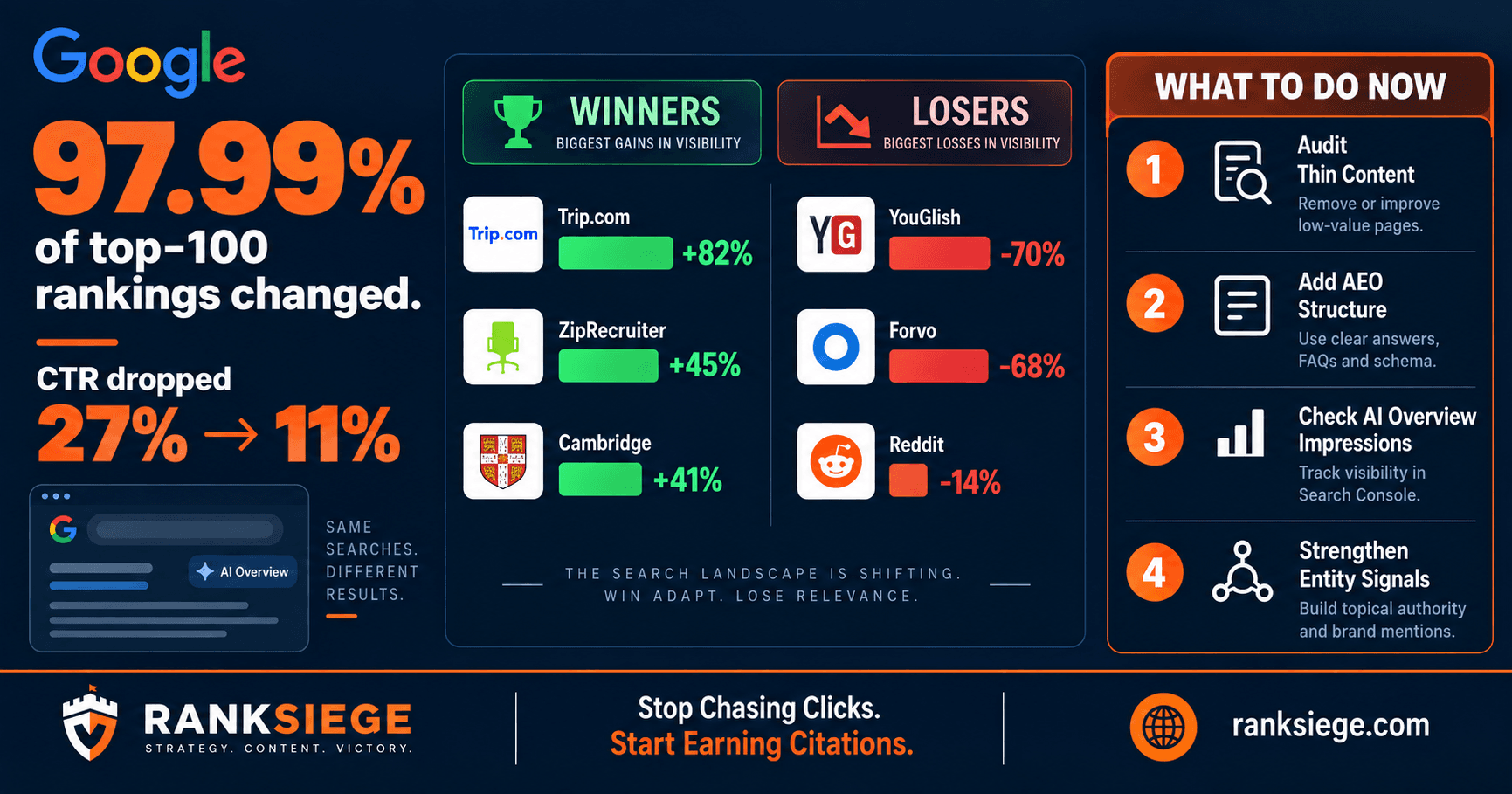
The Google May 2026 Core Update completed on June 2, 2026, and it is one of the most consequential algorithm changes in the past three years. Position-1 click-through rates on AI Overview queries dropped from 27% to 11%, 97.99% of top-100 rankings changed, and sites that built their traffic on aggregating other people's content were hit hardest. This article covers what changed, which sites won and lost, and what the update tells us about where Google's ranking system is heading.
What did the May 2026 Core Update actually change?
The May 2026 Core Update rewrote how Google weighs content originality against derivative or aggregated content. Sites that summarize, repurpose, or collect information from other sources saw traffic drops. Sites that produce original research, primary reporting, or unique data saw gains.
The update also accelerated the shift to AI Overviews. Google began surfacing AI Overview answers on a much wider range of queries, and as a direct result, position-1 CTR on those queries fell sharply. When a user sees a complete AI-generated answer at the top of the page, fewer of them click through to the ranking result. This is structural, not a bug: Google is explicitly trading organic CTR for time-on-Google.
The third major component was entity reinforcement. Sites with strong brand signals, clear authorship, and consistent entity mentions across the web held their positions or gained. Sites that looked authoritative on paper but lacked real-world entity connections took drops.
Which sites lost traffic in the May 2026 Core Update?
The sites that lost the most traffic share several characteristics. They aggregate content from other publishers. They have thin author credentials. They cover topics far outside their core entity focus. The specific numbers tell a clear pattern:
YouGlish, which aggregates YouTube examples of language use, dropped 69.6% in organic traffic. Forvo, which aggregates pronunciation recordings, dropped 68.1%. Reddit dropped 13.7%, though from an extreme high baseline. These are all fundamentally aggregation-dependent businesses.
Sites serving one source type, without producing original analysis or data, lost the most. It is not that Google decided aggregation is wrong in principle. It is that when an AI Overview can answer the same query without the user visiting the aggregator, the aggregator's ranking value drops.
Why did Reddit lose traffic despite being a primary source?
Reddit contains original discussion, which makes it a primary source in one sense. But the update appears to have penalized Reddit for coverage breadth without depth in specific topic areas. A subreddit discussing a topic it is not the recognized authority on no longer gets the benefit of the doubt that Reddit's domain authority previously provided. The specific discussion thread may be original, but Reddit's entity authority is too broad to provide the contextual signal Google is now looking for.
Which sites won in the May 2026 Core Update?
The winners are places with genuine, verifiable authority in their specific domain. Trip.com gained 82.2%, ZipRecruiter gained 44.8%, and Cambridge.org gained 40.9%.
These sites share three properties. They produce original content in a domain where they are the recognized entity (travel booking, employment data, academic publishing). They have strong off-page entity signals: mentions in credible publications, verified authorship, consistent schema. They update their content actively and show clear dates.
Trip.com's win is particularly instructive. Travel is a high-AI-Overview category. Yet Trip.com gained. The reason is that Trip.com is a transaction site: the user who searches for a flight or hotel is not served by an AI Overview that summarizes travel options, they need to click through to book. Google's update correctly assessed that transactional intent still flows to authoritative transactional sites.
Cambridge.org's gain reflects Google's continued investment in educational authority. Academic publishers with real peer-reviewed content now have a stronger signal than a generalist who wrote a blog post about the same topic.
What does the AI Overview CTR drop mean for your website?
The drop from 27% to 11% click-through rate on AI Overview queries is the number most SEO teams should be focused on. It means that if your top keywords now trigger AI Overviews, your organic traffic from those keywords has structurally declined, regardless of whether your ranking position changed.
Our SEO team began tracking AI Overview impression share in Search Console in late 2025. When a client in the B2B SaaS sector (UAE) started appearing in 40+ AI Overview citations, their overall organic clicks actually increased 35%, even as their CTR on individual queries dropped. The reason: AI Overview citation creates brand awareness across queries the site never ranked for before. The traffic distribution changed even though total traffic grew.
If you are not monitoring AI Overview impressions in Search Console's AI Performance Report, you are missing the most important signal in 2026 SEO. This is a separate report from standard organic traffic and requires the AI mode toggle in the Search Console interface.
Is SEO dead because of AI Overviews?
No. SEO is restructuring. The queries where AI Overviews have taken over tend to be informational ("what is X", "how does Y work"). Transactional and navigational queries still send traffic directly to ranking sites. The implication is that informational content now needs to be written for AI citation (AEO) rather than click capture, while transactional content needs stronger conversion optimization because it is carrying more of the revenue load.
What should you do if your site lost traffic in the May 2026 Core Update?
First, determine whether your traffic drop came from AI Overview displacement or from a ranking drop. Check Search Console. If your impressions are up but clicks are down, you are dealing with AI Overview CTR compression. If both impressions and clicks dropped, you have a ranking signal problem.
For ranking drops: audit your content for originality. Google's quality guidelines now explicitly warn against content that "adds no value beyond what can be found elsewhere". Every article on your site should have at least one of: original data, original reporting, a genuine expert voice, or a unique methodology. Generic how-to content that restates what ten other sites say is the profile that lost rankings.
For AI Overview CTR compression: shift your strategy toward AEO. Content optimized for AI citation gets mentioned in AI Overviews, which expands your brand footprint even when the user does not click. Our standard approach is to include a standalone AEO Answer Block immediately after the H1, write FAQ sections that match real People Also Ask patterns, and implement FAQPage schema so the content is indexable for AI engines.
One financial services client in Australia saw a 40% recovery in traffic within 10 weeks after we removed their thin content, rewrote their 12 most important articles with original commentary from a named ASIC-registered advisor, and added AEO structure throughout. The update hurt them specifically because their content had no genuine expert voice. The fix was direct.
How does the May 2026 Core Update relate to E-E-A-T?
The update is E-E-A-T enforcement in practice. Google's ranking guidelines describe Experience, Expertise, Authoritativeness, and Trustworthiness as the dimensions that determine content quality. The May 2026 update appears to have tightened the technical implementation of these signals.
Experience means first-hand evidence. Expertise means demonstrable knowledge depth, not just keyword coverage. Authoritativeness means recognition from other trusted entities. Trustworthiness means transparency about sources, dates, and authors.
Sites that lost traffic often had content that satisfied keyword coverage but failed the experience test. No first-person examples. No named credentials. No external mentions from credible sources. Google's system can now distinguish between a site that talks about a topic and a site that has genuinely done the thing it is writing about.
What does this mean for Ranksiege clients and strategy going forward?
We are running content audits for all clients post-update to identify which pages lost ranking signal and why. The pattern we see most often is what we call thin authority: the site has real expertise in their core service but wrote content covering adjacent topics outside their domain. A roofing company that published content about interior design lost more than a roofing company that published content about roof maintenance.
Domain focus is now a ranking factor in practical terms. Sites that stay within their entity's recognized territory outperform those that chase keyword volume outside it.
For new clients, we build a content topic map before writing a single article. Every topic we recommend passes a domain relevance test: can we write this in a way that extends the client's established entity authority, or are we building on ground the site has no footprint on? If it is the latter, we recommend building that footprint first with structured citation, PR, and partnerships, then publishing the content.
If you want to know whether your site is set up to recover from the May 2026 Core Update or to gain from the next one, start with a free 200-point audit. We assess content originality, entity signals, and AEO structure across your full site.