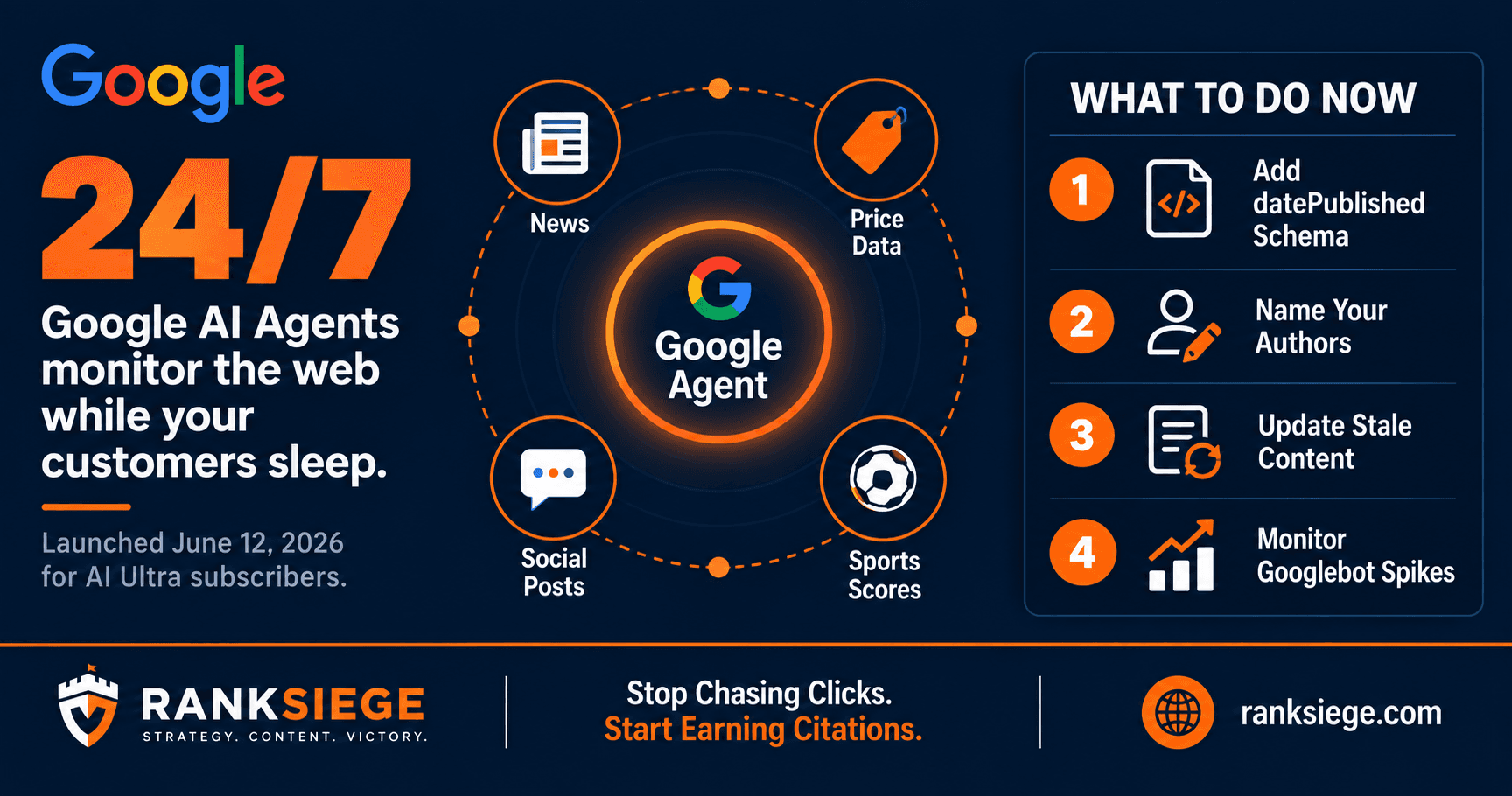
Google now runs AI agents in the background of Search, monitoring the web 24 hours a day on behalf of its users. These information agents, announced at Google I/O 2026 and available to AI Ultra subscribers from June 2026, track prices, job listings, competitor moves, news stories, and anything else a user sets them to watch. For businesses, this creates a new category of search visibility that no one has had to think about before now.
What are Google's Information Agents?
Information agents are persistent AI programs that run inside Google Search without the user actively searching. A user sets a topic or a question once ("alert me when flights from London to Dubai drop below £400" or "monitor news about AI regulation in the EU"). The agent then continuously scans Google's index, financial feeds, sports data, and social posts, and notifies the user when something relevant changes.
They were announced at Google I/O 2026 and launched first for Google AI Pro and AI Ultra subscribers. As of June 12, 2026, they are live for AI Ultra subscribers across all AI Mode languages and markets, according to TechCrunch. Google has stated they will expand availability to broader tiers over time.
The key word here is continuous. These agents do not wait for a user to open Google. They run in the background, much like a monitoring service, and push notifications to the user's device when they find something worth reporting.
How are information agents different from setting a Google Alert?
Google Alerts, which have existed since 2003, send email notifications when new pages match a keyword. Information agents go much further. They pull from live financial data, social posts, sports scores, and Google's full index simultaneously. They can synthesize across sources: not just "this article mentions your keyword" but "three separate sources suggest this trend is accelerating, and here is a one-paragraph summary."
They also integrate with other Google services. An information agent tracking apartment prices in a specific city can cross-reference with Google Maps, Google Finance, and Gmail if given permission. The result is more context, not just a raw alert.
For marketers, the difference matters. A Google Alert can tell a competitor you published a new page. An information agent can tell them your new page is gaining traction, that three industry blogs linked to it, and that search volume for the related keyword is rising. That level of intelligence, previously requiring a paid monitoring tool, now ships inside Google Search for subscribers.
Why does this matter for your website and SEO?
If users set agents to monitor topics related to your business, your content either appears in those agent reports or it does not. This is a new visibility layer that sits on top of traditional search rankings.
The agents pull from the same index Google's AI Overviews use. Content that is well-structured, clearly attributed to a credible source, and regularly updated has a higher chance of being surfaced in agent reports. Thin or stale content is filtered out because the agent is looking for what is new and relevant, not just what ranks.
There is also a crawl concern. Across millions of users each running multiple persistent agents, the cumulative number of automated fetches Google sends to websites rises significantly. Sites that load slowly, block Googlebot, or have inconsistent crawl permissions may lose coverage in agent reports before they lose it in regular search.
We recommend our clients ensure their technical SEO baseline is clean: fast load times, no robot blocks on valuable pages, fresh sitemaps updated whenever content changes. These factors were always important. They are more important now that crawl frequency is increasing.
What content gets surfaced in agent reports?
From what we can observe so far, information agents prioritize content that is:
- Timestamped clearly: content with explicit publish and update dates ranks higher in recency-weighted agent queries
- From a named source: branded entities (Ranksiege & Co, Search Engine Land, Google, etc.) are cited more often than anonymous or thin-author content
- Specific and factual: agents extract discrete data points, not opinion paragraphs. A post that says "Google confirmed the update completed June 2, 2026, affecting 97.99% of top-100 rankings" is more citable than "Google made a big update recently"
- Structured with schema: Article schema with datePublished, dateModified, and a named author increases the agent's confidence in the content's freshness and authority
How should businesses respond to information agents?
The practical response is content operations discipline. Publish with dates. Update content when things change. Sign articles with a real author name and credential. Keep technical health clean.
One B2B SaaS client we work with in the UAE had a content library of 80+ articles, none of which showed publish dates on the page. Their bylines were generic (just "Ranksiege Team" with no credentials). After we added schema with explicit dates, updated their ten most important articles with fresh data, and added named author bios, their Search Console AI Performance Report showed a 40% increase in AI Overview impressions within eight weeks. The same principles apply to information agent visibility.
Should you try to set agents to monitor your own brand?
Yes. Setting Google Information Agents to track your brand name, your competitors' brand names, and your primary keywords is now a legitimate competitive intelligence practice. You will see what Google surfaces about you in real time, and you will know when a competitor publishes content that is gaining traction before it climbs to page one.
This is not new territory. Most enterprise SEO teams already use tools like Mention, BrandWatch, or Ahrefs Alerts for this. The difference is that Google's agents draw directly from the same data source that determines search rankings. The signal is cleaner.
What are the downsides and concerns?
Not everyone is happy about information agents. Privacy researchers have raised concerns about the scale of automated monitoring these agents enable on users' behalf. For website owners, the concern is different: if millions of subscribers run persistent agents, websites absorb a significant increase in bot traffic from Google's crawlers, none of which generates a human visit or a conversion.
This is not a solved problem. Google has not published specific data on how it plans to manage the crawl load increase. Our recommendation to clients is to monitor server load over the next two quarters and flag any unusual spikes in Googlebot traffic. If your hosting plan charges for bandwidth, this is worth watching.
What does this mean for Ranksiege clients?
We are already factoring information agent visibility into our content audit process. When we run a 200-point site audit, one of the dimensions we check is content freshness signals: are publish dates shown, are articles updated with a dateModified schema field, are authors named? These were always part of a sound SEO practice. They now carry extra weight.
For clients on our SEO plan at $299/mo, content structure updates for agent visibility are included. We update schema, add dateModified fields to existing pages, and flag stale content for a refresh cycle. If you want to know where your site stands, start with a free audit at free 200-point audit.