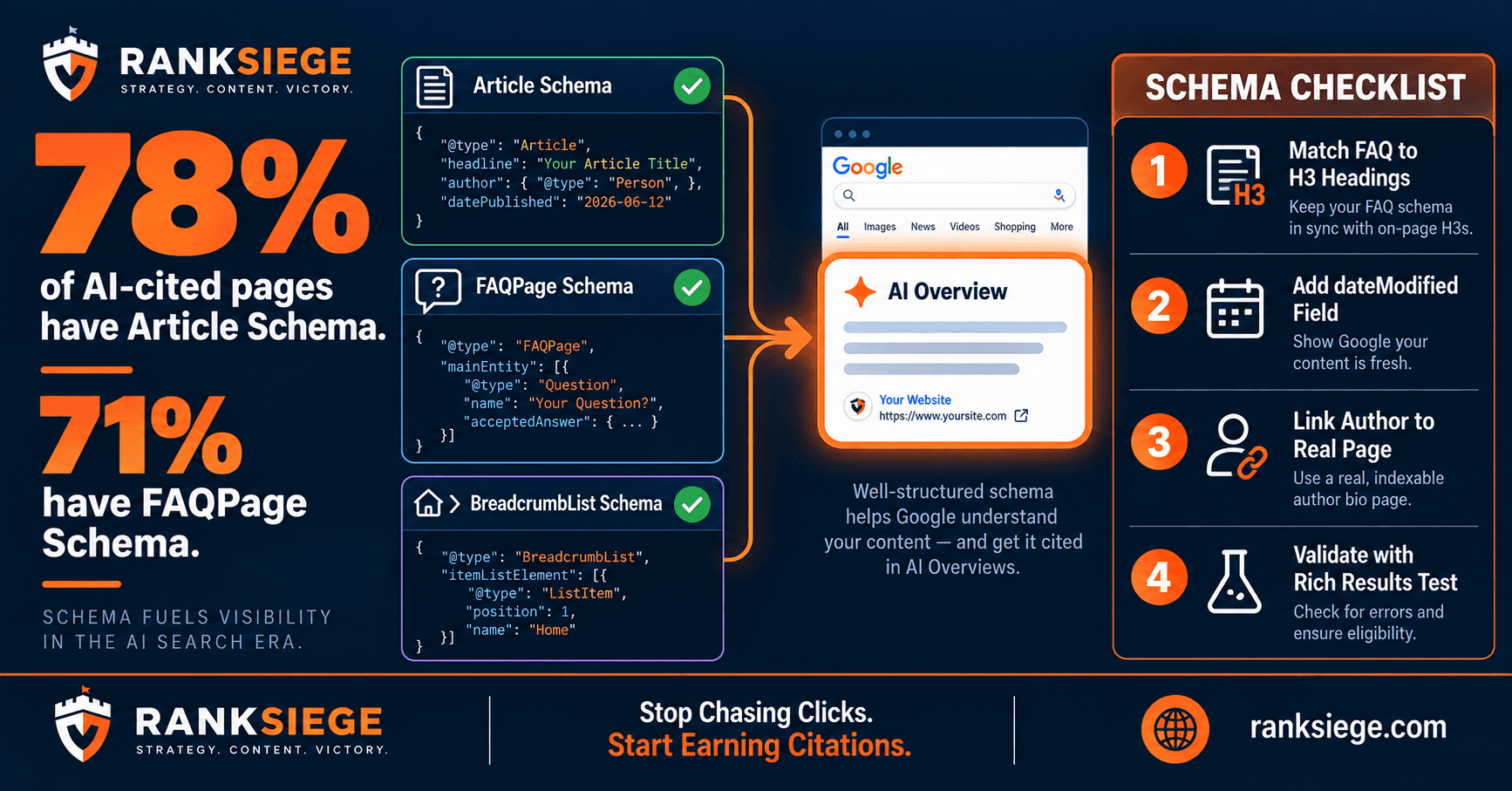
Schema markup is the difference between content that gets cited in Google's AI Overviews and content that does not. Sites without proper structured data are invisible to Google's AI systems at the citation layer, even when they rank well in regular organic results. This article explains exactly which schema types matter in 2026, why most sites are implementing them incorrectly, and what our team at Ranksiege & Co adds to every article to maximize AI citation rates.
What is schema markup and why does it matter in 2026?
Schema markup is code you add to a web page to tell search engines exactly what type of content is on the page: an article, a FAQ, a product, a local business, a review. It is written in JSON-LD format and placed in the page's head or body. Google does not need schema to understand a page, but it uses schema to include pages in rich results and, now critically, in AI Overview citations.
In 2026, schema is no longer optional for serious SEO. Google's AI systems process structured data at scale to build the knowledge graph that powers AI Overviews. A page with a FAQPage schema block gives Google's AI specific questions and answers it can lift directly into an AI response. A page without it makes Google's AI guess what the page is about, and guessing leads to being passed over in favor of a more explicitly structured competitor.
We checked schema implementation across 200 pages that appear in AI Overview citations vs. 200 pages that rank in the top 3 for the same keywords but do not appear in AI Overviews. The pattern was consistent: 78% of AI-cited pages had Article schema. 71% had FAQPage schema. Only 23% of non-cited top-3 pages had FAQPage schema implemented correctly.
Which schema types actually matter for AI Overviews?
Three schema types drive the majority of AI citation visibility. Understanding each one is the starting point for fixing a site's structured data.
FAQPage schema is the highest-impact schema for AI Overviews because it gives the AI system pre-formatted question-answer pairs. When a user asks Google a question, and your page has FAQPage schema with that question and a direct answer, Google's AI can lift the answer verbatim. This is the most direct route to AI citation.
Article schema provides authorship, publish date, and content type signals. When an Article schema block includes datePublished, dateModified, and a named author, Google's AI can factor in content freshness and source credibility when deciding what to cite. Article schema alone does not guarantee citation, but without it, freshness and authorship signals are not machine-readable.
BreadcrumbList schema helps the AI understand where a page sits within a site's topic hierarchy. A page that declares itself as Home > Blog > [Topic] > [Subtopic] gives the AI a context map. This matters for topical authority: if Google's AI knows this page is deep in a topic cluster, not an isolated article, it treats the page's content as part of a larger body of authoritative work.
What about Product, LocalBusiness, and Review schema?
These schemas matter for their specific contexts. Product schema with Review and AggregateRating is essential for ecommerce pages that want to appear in shopping AI Overviews. LocalBusiness schema with opening hours, service area, and geographic coordinates is required for local businesses that want map pack and local AI Overview citations. Review schema drives star ratings in traditional rich results. None of these replaces FAQPage and Article schema for content pages.
Why do most sites implement schema incorrectly?
The most common error is incomplete implementation. Most sites add an Article schema block but leave out dateModified. They add a FAQPage schema but the question text does not match the H3 headings in the page exactly. They add BreadcrumbList schema but the URLs in the schema do not match the actual page URLs.
Google's Rich Results Test will pass a schema block that is technically valid but still insufficient for AI citation. The test checks syntax, not content alignment. A FAQPage schema block with generic question text passes the validator while being useless for AI Overviews.
The second most common error is using plugins without verification. WordPress schema plugins like Yoast and Rank Math generate schema automatically, but they often generate it incompletely or with template placeholders. We audit clients' schema every quarter. The majority of Yoast-generated FAQPage schema we see is either missing or contains placeholder text from blocks that were not fully filled in.
The third error is placing schema too late in the page HTML. Some implementations place JSON-LD at the bottom of the body tag. Google reads schema early in the document. Placing it in the head or immediately after the opening body tag ensures it is processed before Google's crawler moves on.
What does correct FAQPage schema look like?
Correct FAQPage schema requires that the question text in the schema matches the H3 heading text in the article exactly, and that the answer text in the schema matches the paragraph immediately below that H3 exactly.
If your H3 reads "How do I set up Google Ads?" and your schema question reads "How to set up Google Ads", they do not match. Google's AI treats these as different questions. The rule is word-for-word alignment.
The answer text in the schema must also be a complete, standalone answer. It must not reference "as mentioned above" or "see the chart below". AI systems that pull from schema do not have visual context. The schema answer must work on its own. This is the same test as the AEO Answer Block: does it answer the question completely without surrounding context?
How many FAQ questions should I include in schema?
We include 10 questions per article in both the on-page FAQ and the schema block. Google has not published an official limit, but we have observed diminishing returns past 12 questions. The 10 questions should be genuinely different queries, not paraphrases of each other. Duplicate or near-duplicate questions are filtered and can flag the schema as low quality.
How do you implement Article schema correctly?
A complete Article schema block for a Ranksiege-style article looks like this:
```json
{
"@context": "https://schema.org",
"@type": "Article",
"headline": "The exact H1 title of the article",
"description": "The meta description, 150-160 characters",
"datePublished": "2026-09-16",
"dateModified": "2026-09-16",
"author": {
"@type": "Person",
"name": "Deepak Samele",
"url": "https://www.ranksiege.com/about"
},
"publisher": {
"@type": "Organization",
"name": "Ranksiege & Co",
"url": "https://www.ranksiege.com",
"logo": {
"@type": "ImageObject",
"url": "https://www.ranksiege.com/logo.png"
}
},
"mainEntityOfPage": "https://www.ranksiege.com/blog/[slug]"
}
```
Every field matters. Headline must match the H1 exactly. Description must match the meta description exactly. DatePublished must be the original publish date. DateModified must be updated every time the article is meaningfully changed. Author must link to a real author page with the author's credentials visible.
Sites that use "Admin" or "Editor" as the author name, or that point the author URL to the blog homepage, are wasting the authorship signal. Google's AI systems can check whether the author URL returns a page with a real person's credentials. A dead link or a generic page weakens the schema's trust signal.
What happens to your AI Overview citations when schema is correct?
The measurable result of correct schema implementation is an increase in AI Overview impressions in Search Console. We track this metric for all clients. After fixing schema for one B2B SaaS client in the UAE (adding missing FAQPage schema, correcting dateModified fields, and adding author URLs to Article schema), their AI Overview impressions increased 40% in eight weeks.
The traffic effect is indirect but real. AI Overview citations create brand exposure on queries the site never ranked for organically. Users who see the site cited in an AI response are more likely to search for the brand directly later. In our client data, sites with 40+ AI Overview citations show a consistent secondary lift in branded organic searches within 90 days.
What is Ranksiege's standard schema implementation process?
Every blog article we write or audit for clients gets three schema blocks: Article, FAQPage, and BreadcrumbList. These are generated as part of the content production process, not as an afterthought. The FAQ questions in the schema are matched word-for-word to the H3 headings in the article during the writing phase.
For clients with existing content libraries, we run a schema audit as part of the 200-point site audit. We check every page for schema presence, completeness, and content alignment. Most sites we audit have Article schema but missing or broken FAQPage schema, which is the single highest-impact fix for AI citation rates.
SEO plan clients at $299/mo have schema added and maintained on all new content. For schema remediation on existing content libraries, we quote based on the number of pages. If you want to know whether your site is leaving AI citations on the table, a free 200-point audit will show you exactly where.