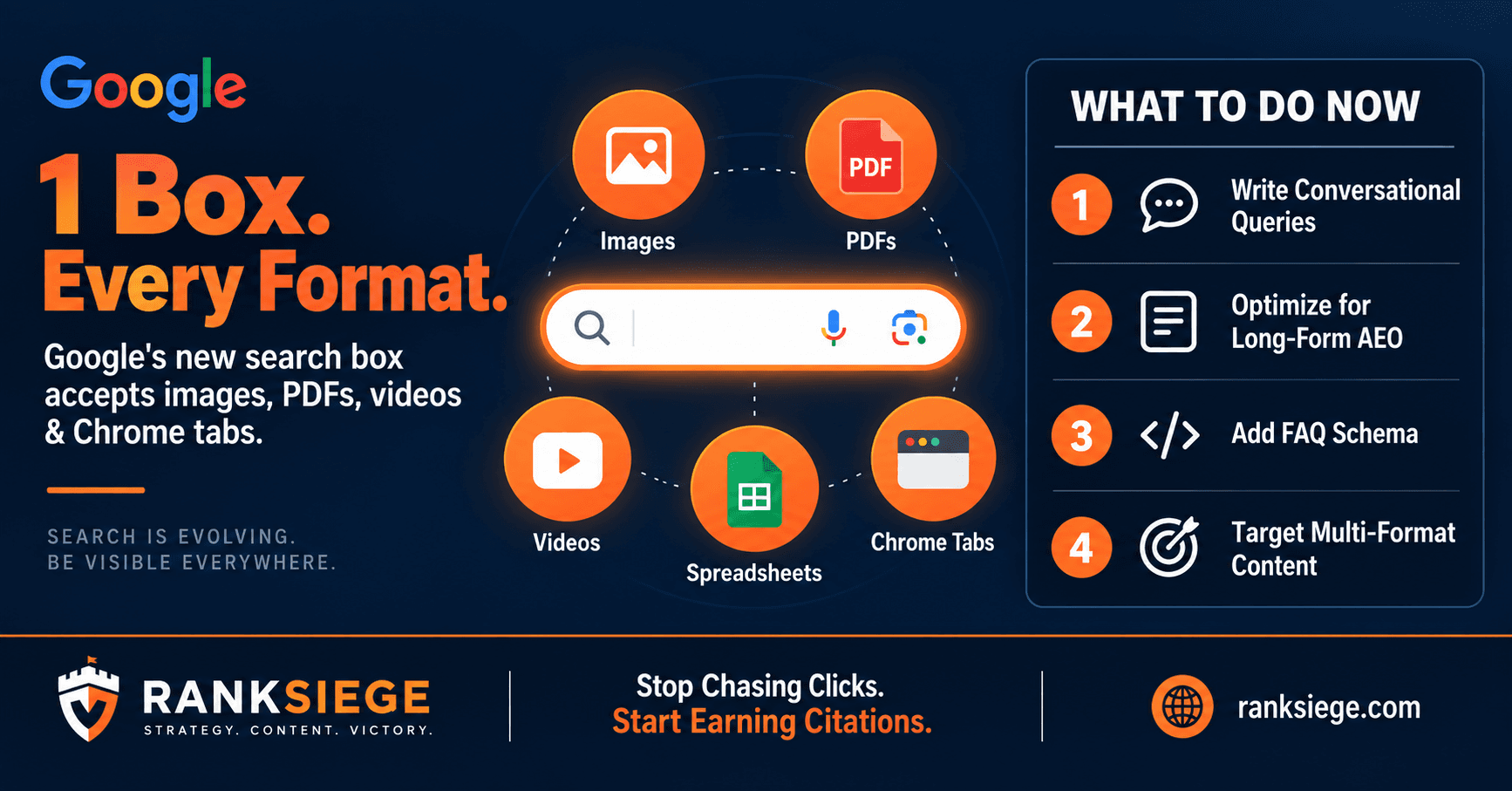
Google just changed its search box for the first time in 25 years. The new Intelligent Search Box, announced at Google I/O 2026, accepts text, images, PDFs, videos, spreadsheets, and open Chrome tabs as inputs. For anyone who runs a website or manages search traffic, this is not a cosmetic update. It changes how people form search queries, which changes what you need to rank for.
What exactly is Google's Intelligent Search Box?
The Intelligent Search Box is a redesigned search interface that runs on Gemini 3.5 Flash. It grows downward as you type, encouraging longer, more conversational queries instead of the 3-to-5 keyword phrases most people used before. You can drag a PDF lease agreement into it and ask about late fees. You can drop a video clip of a broken appliance and get a diagnosis. You can upload a spreadsheet and ask questions about the data inside.
It launched on May 19, 2026, and is available across every country and language where AI Mode already works. The old search box was a text field. This one is closer to a chat window with file support baked in.
How does this change the way people search?
The most important shift is query length and format. Keyword-style searches ("best SEO agency USA") are being replaced by natural language searches ("what should I look for in an SEO agency if I run a B2B software company in Houston").
This matters for two reasons. First, AI-coached queries lead directly into AI Mode responses, where a synthesized answer appears instead of a ranked list. Second, the intent behind longer queries is more specific, which means the content that matches them needs to be more specific too.
In our work auditing 50+ brand accounts at Ranksiege & Co, we have seen this pattern hold for years inside voice search data. People who speak a full question get different results than people who type three words. The Intelligent Search Box brings that same behavior to desktop and mobile typed search.
What types of queries will change the most?
Research queries will shift the most. People doing product comparisons, vendor evaluations, or diagnostic questions will use longer inputs. Transactional queries ("buy running shoes size 10") will stay short because the intent is simple.
For B2B companies, this is a significant opportunity. Decision-makers researching software, services, or agencies tend to ask detailed questions. If your content answers those questions completely, you now have a better chance of appearing in the AI Mode synthesis that follows.
What happens to keyword-based SEO?
Short keywords are not dead. But their role changes. They define the topic. The Intelligent Search Box and AI Mode decide which content answers the topic best.
The position-one CTR on AI Overview queries fell from 27% to 11% after Google's May 2026 Core Update, according to data from Relevant Audience. That collapse happened because AI Mode absorbs the click before it reaches the ranked result. To pull actual traffic, your content needs to appear inside the AI synthesis, not just below it.
This is exactly what AEO (Answer Engine Optimization) addresses. You structure your content so AI systems can extract a clean, citable answer. The Intelligent Search Box feeds those longer queries directly into the AI system that then pulls from content built the AEO way.
What does the Intelligent Search Box mean for content strategy?
Three specific changes matter for how you plan and write content.
Cover the full question, not just the keyword. If your target query is "how to choose an SEO agency", your content should answer the sub-questions that follow: what certifications to check, what pricing models exist, what results to ask for, how long it takes to see movement. These sub-questions are what AI Mode will pull when it synthesizes an answer from your page.
Use question-format headings. The Intelligent Search Box encourages conversational input. Your H2 headings should mirror the way someone would phrase a question in the new interface: "What results should I expect from SEO in the first 90 days?" not "Expected SEO Results."
Include file-type context where relevant. Users can now upload PDFs, spreadsheets, and contracts. If you offer audits, templates, or reports, mentioning those formats in your content may create new match paths. Google's AI can now connect someone who uploaded a broken audit PDF with an agency that explains audit methodology on their website.
Which businesses are most affected?
B2B companies and professional service firms will feel this change the most, and it cuts both ways.
On the upside: buyers researching vendors now enter far more detailed queries. If you have covered those exact questions in your content, you match queries your competitors cannot. A law firm that has written 400 words on "what to look for in a business immigration lawyer for a tech startup in Texas" will now surface for queries that previously went unmatched.
On the downside: content that is thin, generic, or derivative will be outcompeted faster. The Intelligent Search Box routes sophisticated queries to AI Mode, which cites primary sources. If your content is just a reworded version of what someone else wrote, it will not be cited.
We saw this play out clearly with a B2B SaaS client in the UAE. After we rewrote their service pages to cover specific sub-questions (not just the primary keyword), they went from zero AI Overview appearances to 40+ within five months. That work was done before the Intelligent Search Box launched. With the new interface in place, the same approach will deliver faster results.
What about local businesses and ecommerce?
Local queries are less affected in the short term. "Plumber in Manchester" still resolves quickly and local packs still appear. But even local queries are shifting toward more descriptive language: "emergency plumber Manchester available Saturday" or "family dentist Croydon that accepts NHS patients." That specificity rewards businesses with complete, accurate content on their Google Business Profile and website.
Ecommerce businesses face a different challenge. Product queries may increasingly arrive with a photo attached ("find me a lamp that looks like this") or a description from a video. Visual search and multimodal input are growing. If your product imagery and alt text are thin, you are missing that search path.
What should you do right now?
The Intelligent Search Box is live now. Three things you can do this week that will actually make a difference:
Audit your top 10 pages for sub-question coverage. Open each page and ask yourself: if someone asked this question in AI Mode, which supporting questions would the AI need to answer? Does your page cover them? If not, expand those sections.
Reformat your headings as questions. A heading like "Our SEO Process" answers nothing. "How does our SEO process work for a new site?" is an exact match for what the Intelligent Search Box will surface.
Run a free 200-point audit to see which of your pages are already structured for AI Mode and which need work. We check AEO structure, heading format, sub-question coverage, and schema in one report.