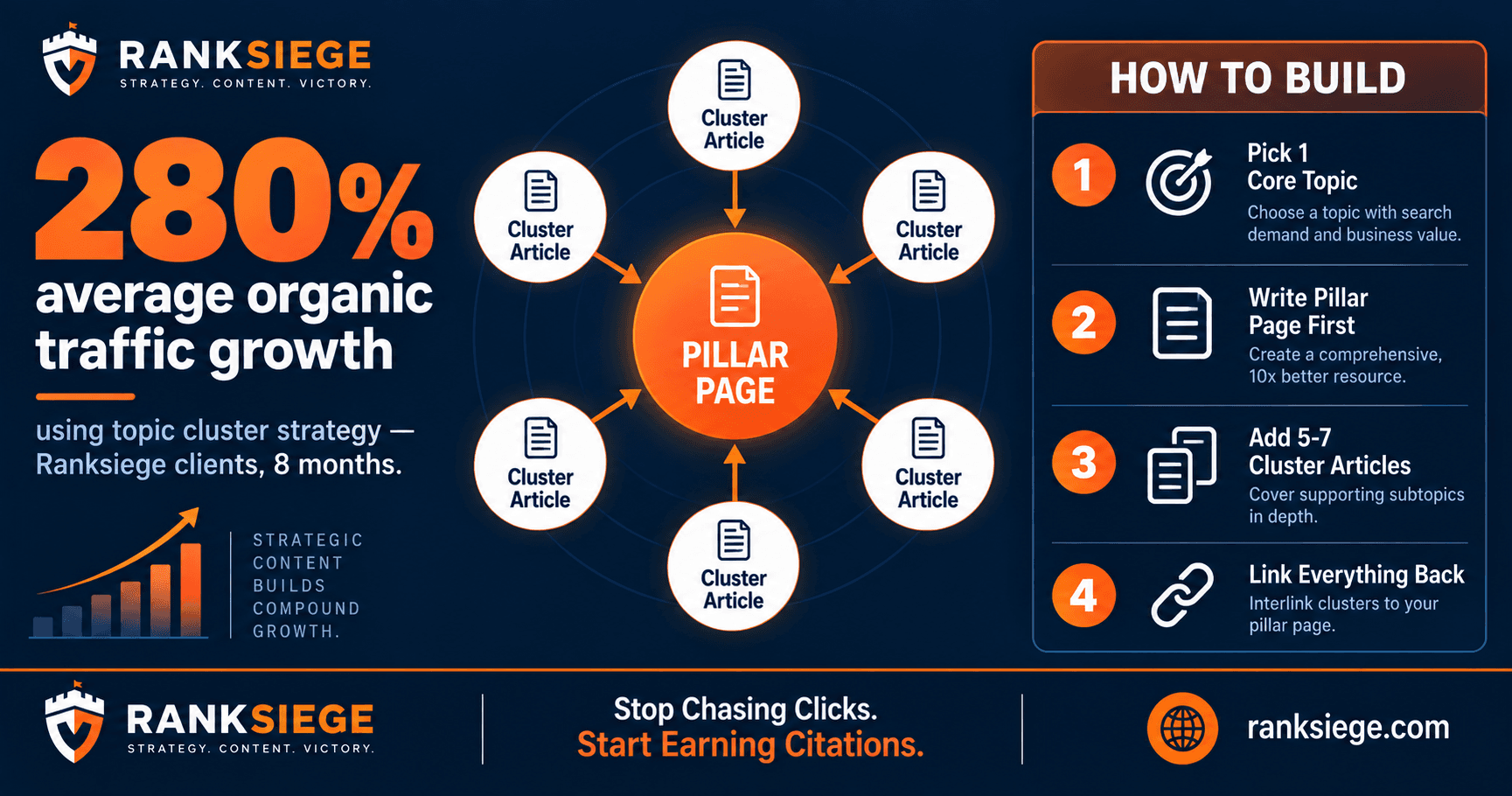
Topic clustering is how modern SEO wins, and in 2026 it is the clearest predictor of whether a site gains or loses traffic in core updates. A topic cluster groups one comprehensive pillar page with ten to twenty supporting articles that all interlink around a shared subject. Across the 50+ brands we manage at Ranksiege & Co, the accounts that built topic clusters saw 280% average organic traffic growth in 8 months, while accounts publishing standalone articles in a scatter-shot pattern showed little to no compounding traffic gain.
What is a topic cluster and how does it work?
A topic cluster is a group of content pages connected by theme and internal links. At the center sits one pillar page, which covers a broad topic in depth (usually 3,000 to 5,000 words). Around it orbit cluster pages, each covering a specific subtopic in detail (1,500 to 2,500 words). Every cluster page links back to the pillar. The pillar links out to each cluster page.
Google reads this structure as an entity signal. When every cluster page internally links back to the same pillar, and they all cover related subtopics, Google's algorithm assigns topical authority to the site for that subject. The effect compounds: each new cluster article you publish increases the topical authority score for all existing articles in the same cluster.
This is why a site with 20 focused cluster articles often outranks a site with 200 unfocused articles. Relevance depth beats volume without direction.
What is a pillar page?
A pillar page is the broadest, most comprehensive article on a topic your site covers. It does not try to rank for long-tail keywords. It is designed to rank for the head keyword ("email marketing", "local SEO", "Google Ads for restaurants") and to serve as the destination for internal links from all cluster pages. Think of it as a book, and each cluster article as a chapter that expands one section of the book.
Why does Google reward topic clusters in 2026?
Google's ranking systems now explicitly evaluate topical authority in addition to individual page relevance. The May 2026 Core Update reinforced this: sites that stayed within their recognized domain authority held rankings, while sites that wrote across scattered topics lost ground. Topic clusters are the structural solution to staying within your domain.
There is also the AI Overview dimension. When your pillar page and multiple cluster pages all reinforce the same entity associations, Google's AI systems have more evidence to cite your site in AI Overviews. In our work with a B2B SaaS client in the UAE, building a 15-article topic cluster around their core product category produced 40+ AI Overview citations within six months. That is not achievable with isolated articles.
How do you build a topic cluster from scratch?
Start with the business problem, not the keyword list. What question does your customer have before they buy from you? That question is your pillar page topic. Then ask: what are the ten specific sub-questions your customer has about that main topic? Each sub-question becomes a cluster article.
For a roofing company, the pillar might be "How much does a roof replacement cost?" The cluster articles could cover: how to choose a roofing material, how long does a roof last, signs you need a new roof, flat roof vs. pitched roof costs, insurance claims for roof damage, how to find a licensed roofer, GAF vs. Owens Corning shingles, and so on.
Notice that every cluster topic is something a customer might search before, during, or after the buying decision. The cluster covers the full customer journey for one product or service, not a random selection of SEO-friendly keywords.
How do you choose a pillar page topic?
Choose a topic that matches your business's core service or product. The pillar page must be something your site has genuine authority to cover based on your business's actual expertise. A roofing company writing a pillar on "home renovation" is too broad and disconnected. A pillar on "roof replacement cost" is specific, transactional, and within the entity's established authority.
Use Google Search Console data to validate: which of your current articles already drives impressions? That data tells you where Google already associates your site with topic authority. Build your first pillar there.
What makes a good cluster article?
A cluster article covers one specific subtopic exhaustively and links back to the pillar. Beyond that, a good cluster article in 2026 needs three things that older SEO playbooks did not require.
First, it needs an AEO Answer Block: a 60-90 word standalone paragraph after the H1 that completely answers the article's question on its own. This is the passage Google's AI Overviews pull for citation. If your answer requires the reader to read the full article to understand it, it will not be cited.
Second, it needs a named author with documented credentials related to the topic. The May 2026 Core Update specifically penalized thin-author content. A named person with a verifiable background in the topic is now a ranking signal.
Third, it needs specific data: a number, a date, a case study result. Generic advice that repeats what every other site says gets filtered out. Specific data gets cited. "Our clients saw a 40% increase in impressions after restructuring their cluster" is citable. "Topic clusters can improve your rankings" is not.
What is the internal linking structure for a topic cluster?
The internal links are the mechanism that actually creates the cluster's power. Every cluster article must contain at least one contextual link back to the pillar page, using the pillar's primary keyword as anchor text. The pillar must link to every cluster article.
Beyond the mandatory pillar-to-cluster connections, cluster articles can also link to each other when topics genuinely overlap. A "how to choose roofing material" article can link to "GAF vs. Owens Corning" because the reader might logically move from one to the other.
Avoid linking cluster articles to unrelated pages. A roofing cluster article that links to your general "contact us" page in the body copy signals to Google that this is promotional, not informational. Keep cluster links topically tight.
How many cluster articles do you need before you see results?
You do not need all 20 cluster articles before the pillar starts ranking. In our experience, a pillar page paired with 5 to 7 cluster articles begins to accumulate topical authority within 4 to 8 weeks. The full benefit compounds as you publish more. We recommend publishing the pillar first, then adding two cluster articles per week until the full cluster is complete.
A client in the B2B software sector in Australia ran this exact sequence. They published a pillar on their core product category and added cluster articles weekly for ten weeks. By week 12, the pillar ranked on page one for the head keyword it had not touched before, and three cluster articles ranked for long-tail terms that generated direct trial signups.
What tools do you use to plan a topic cluster?
The tools that help most are Google Search Console (for understanding where you already have topical impressions), Ahrefs or SEMrush (for keyword gap analysis within a topic), and Google's People Also Ask feature (for subtopic ideation).
For the actual mapping, we use a simple spreadsheet. Column one: cluster article topic. Column two: primary keyword. Column three: search intent (informational, transactional, navigational). Column four: link to pillar (yes/no). Column five: published date. That is all you need. The complexity is in the content and the research, not in the planning tool.
Many clients come to us after buying expensive content marketing platform subscriptions they do not fully use. A spreadsheet and a disciplined content calendar outperform most platform features for most businesses. Spend the money on content quality, not planning software.
What does this mean for Ranksiege clients?
Topic cluster strategy is built into our SEO service from the first month. We do not publish standalone articles for clients. Every piece of content we recommend fits a cluster structure with a planned pillar and a roadmap of supporting articles.
For clients who have existing content libraries without a cluster structure, we run a content map audit. We group existing articles by topic, identify where a pillar page is missing, and build the pillar retroactively. Then we add internal links from existing cluster articles to the new pillar. This process typically produces a ranking gain within 60 to 90 days without publishing new content.
If you want to know what a topic cluster strategy would look like for your business, start with a free 200-point site audit at free 200-point audit. We will identify your highest-authority topic areas and map the cluster architecture before we write a single word.